Big tech is strangling small health businesses – & calling it quality control

Opinion. The facts cited are sourced. The conclusions are my own.
Something is happening to small complementary and integrative health businesses across Australia, the United States, and beyond — and it is not being talked about loudly enough.

Practitioners who have spent decades studying, building expertise, accumulating clinical experience, and creating genuinely useful health content are watching their businesses collapse. Not because they have done anything wrong. Not because their information is inaccurate. Not because the people they serve don’t value what they offer.

Because Google decided they shouldn’t be found.

I am one of those practitioners. I have been a functional nutritionist for nearly a decade, working with women navigating complex, unresolved chronic health conditions — the kind conventional medicine may dismisses or can’t explain. My business was built on Google search traffic. Then Google changed the rules. And I have a very specific problem with how that change is being framed.

This is not a new pattern

Before examining what has happened in recent years, it is worth understanding that Google’s tendency to use its platform power in ways that benefit pharmaceutical interests is not new.

In 2010, TechNewsWorld reported on Google’s sudden change to its AdWords policy for online pharmacies — switching from PharmacyChecker as its validation standard to the NABP’s VIPPS programme. The effect was to immediately disqualify hundreds of legitimate online pharmacies that helped consumers access affordable medications from overseas, while exclusively approving large institutional pharmacies — CVS, Walgreens, Aetna, Caremark.

Gabriel Levitt, Vice President of PharmacyChecker, said at the time: “If you look at all the media reports, if you look at all the activities of the NABP, of groups obviously funded by the pharmaceutical industry, you see they’ve been putting pressure on the search engines in ways that would benefit the big companies’ interests, which is prices.”

When asked directly whether pharmaceutical companies had pressured Google into changing its policy, Google declined to explain its reasoning. “We’re unable to share anything more beyond that,” a spokesperson said.

The pattern established then — algorithmic policy changes that benefit large pharmaceutical interests at the expense of smaller operators, with no explanation and no appeal — has been playing out at an accelerating pace ever since.

Google is not a neutral platform

In August 2024, a US federal judge ruled that Google had violated Section 2 of the Sherman Antitrust Act — finding the company had illegally maintained a monopoly in search and related advertising. This was not a close call. It was a 277-page opinion following a nine-week trial.

Central to that monopoly: Google pays Apple approximately $20 billion annually to remain the default search engine on every iPhone, iPad, Mac, and Safari browser. This was revealed under oath during the 2023 antitrust trial.

Twenty billion dollars a year — to ensure that when people search for health information, it is Google that decides what they find.

This is not a neutral arbiter of information quality. This is a company found guilty of operating an illegal monopoly, that has positioned itself as the gatekeeper of what health information reaches the public.

Google’s financial relationship with pharmaceutical medicine

Google’s relationship with pharmaceutical medicine extends far beyond advertising.

CB Insights has documented that Google — through its parent company Alphabet and its pharma-focused ventures Verily Life Sciences, Calico Life Sciences, and Isomorphic Labs — has made over 90 investments in the pharmaceutical sector in recent years. Google and Sanofi announced a joint venture drug discovery collaboration. Four major pharmaceutical companies signed onto Verily’s Project Baseline. Google’s Project Nightingale reportedly gathered health data from millions of patients within Ascension’s health network without their knowledge — raising profound questions about who ultimately benefits from that data.

On the advertising side, the US healthcare and pharmaceutical industry was projected to spend approximately $19.66 billion on digital advertising by end of 2024 — with Google as the primary platform.

Google is not merely a search engine that occasionally carries pharmaceutical advertising. Google is a direct financial participant in pharmaceutical medicine — with investments, partnerships, joint ventures, and advertising relationships that create a profound structural alignment of financial interests between Google and the conventional pharmaceutical industry.

This context is essential when evaluating whose health information Google’s algorithm elevates — and whose it suppresses.

The algorithm changes & what they actually did

2019 — the first significant hit

In 2019, Google rolled out an algorithm update that removed many natural health and health freedom websites from organic search results — with some sites losing as much as 99% of their traffic. The sites most affected were disproportionately those offering health perspectives that diverged from conventional pharmaceutical medicine.

My website traffic dropped 42% with this change.

2024 & 2025 — the sustained assault

Google’s March 2024 and subsequent core updates devastated the broader health and wellness sector under the banner of the E-E-A-T framework — Experience, Expertise, Authoritativeness, and Trustworthiness.

On paper this sounds reasonable. In practice, it functions as a credential filter that systematically elevates institutionally affiliated medical sources — hospitals, pharmaceutical-funded medical journals, government health bodies — while suppressing independent practitioners regardless of their actual expertise or clinical outcomes.

67% of health sites were significantly affected. Recovery timelines run 6-12 months — considerably longer than any other industry. For small independent practices that depend on search traffic for client acquisition, a 6-12 month revenue loss is not a disruption. It is an existential event.

A practitioner with 20 years of clinical experience, personally recovered from the conditions they treat, with extraordinary documented client outcomes — is algorithmically ranked below a pharmaceutical company’s health information page. Not because the pharmaceutical company’s information is better. Because it has institutional affiliation. Because it has the right kind of credentials in Google’s framework. Because, one might reasonably infer, it spends significantly on Google advertising.

This is not quality control. This is market protection.

Then came AI overviews — the final blow

If the algorithm changes represented a slow squeeze on complementary health practitioners, Google’s rollout of AI Overviews has been the accelerant.

AI Overviews are AI-generated summaries that appear at the top of Google search results, providing a direct answer to the query without requiring the user to click through to any website. The traffic that previously went to independent health websites now stays on Google’s page.

The data on this is stark:

When AI Overviews are present, click-through rates drop to just 8% — compared to 15% for traditional search results. Organic click-through rates for informational queries have fallen 61% since mid-2024. Paid click-through rates on the same queries have fallen 68% — meaning even advertising is being undermined. 60% of all Google searches now end without any click to any website at all.

Health is the sector most comprehensively targeted. In information-driven health queries, up to 67.5% are now answered directly by AI — meaning the vast majority of health searches no longer send anyone to a website. Informational health content is experiencing 40-70% traffic drops as AI answers are deemed “good enough.”

And who does the AI draw its answers from? Institutionally credentialled medical sources. The same sources Google’s algorithm already favoured. The same industry with which Google has tens of billions of dollars in financial relationships.

The irony is not subtle. Google has built an AI that answers health questions — drawing on the institutional medical sources its algorithm has spent years elevating — and in doing so has rendered independent health websites largely invisible. The circle is complete.

Meta is doing the same thing

Google is not acting alone.

Meta — the owner of Facebook and Instagram — has implemented health content restrictions that have decimated organic reach for complementary health practitioners on social media. Posts that were reaching thousands of engaged followers organically a few years ago now reach dozens. The algorithm suppresses health content that doesn’t align with mainstream medical consensus.

The advertising picture is equally revealing. From January 2024, Google expanded its healthcare and medicines policy to treat all health-related advertising with the same restrictions as pharmaceutical advertising — requiring certification and compliance with stringent content policies that pharmaceutical companies can navigate easily but independent practitioners often cannot.

The result: organic reach is throttled. Advertising is restricted or prohibitively expensive. The health information that flows freely on these platforms is the health information that aligns with their largest pharmaceutical and medical advertisers. Everything else is algorithmically invisible.

The qualifications argument doesn’t hold

The standard defence of these changes is quality — that Google is simply elevating credentialled, evidence-based health information over misinformation.

This argument collapses quickly.

The practitioners most affected are not conspiracy theorists or misinformation spreaders. They are degree-qualified nutritionists, naturopaths, functional medicine practitioners, and integrative health specialists — many with postgraduate qualifications, professional registrations, and decades of documented clinical experience.

What Google’s algorithm rewards is not expertise. It rewards institutional alignment. A GP with a six-minute appointment and a prescription pad algorithmically outranks a functional nutritionist with 20 years of clinical experience — not because the GP’s information is more helpful, but because the GP has the right institutional affiliation.

Furthermore, in a particularly revealing asymmetry, a Harvard Kennedy School study found that Google simultaneously allowed alternative cancer clinics providing scientifically unsupported cancer treatments to spend millions on targeted advertising to vulnerable cancer patients — while applying stringent restrictions to qualified independent health practitioners advertising legitimate services.

The enforcement is selective. The direction of that selectivity is consistent.

Who is actually being harmed

The people who lose access to independent complementary health practitioners are not people with plentiful conventional alternatives. They are people who have already been through the conventional system. People whose tests came back normal when they felt far from well. People navigating complex, overlapping conditions that may not respond to pharmaceutical treatment protocols.

These are the people most in need of alternative information and perspectives — and these are precisely the people whose access is being algorithmically restricted. Directed back, again and again, to the institutional sources that have already failed to help them.

This is not a theoretical harm. It is happening to real practitioners and real patients, every day, across Australia and globally.

If you want that independent, holistic and science/research-based practitioner who listens, cares and works hard to provide their clients with personalised support that can complement allopathic medicine, then support them. Like their social media posts and comment on them, spread the word that they do exist, use alternatives to google, and give them business as appropriate.

The bigger pattern

What is happening in health is not isolated.

Big tech platforms are systematically suppressing content that competes with the interests of their largest advertisers and financial partners. In health, that means pharmaceutical medicine. In news, that means legacy media. In finance, that means institutional investment. The pattern is consistent: use algorithmic authority to define what counts as legitimate and worthy of amplification — and define it in ways that happen to align with the financial interests of the largest players in each sector.

A federal court found Google’s search monopoly illegal. The remedy imposed barely scratches the surface. Google continues to pay for preferential placement, continues to operate its pharmaceutical investment portfolio, continues to deploy AI that answers health questions from institutional sources while rendering independent health websites invisible.

And it does all of this while describing the exercise as quality control.

What I am asking for

Not immunity from scrutiny. Not the right to spread misinformation.

Honesty about what these changes actually are.

They are not neutral quality filters. They are the exercise of monopoly power — found illegal by a federal court — in the financial interests of the monopoly’s largest partners. The pattern goes back at least to 2010, when Google changed its pharmacy advertising policy in ways that benefited large pharmaceutical companies at the expense of smaller legitimate operators — and declined to explain why.

The practitioners being suppressed are largely qualified, genuinely expert, and serving populations that conventional medicine has failed. Framing their algorithmic erasure as a quality improvement exercise is not honest.

And the public — including the patients who can no longer find the practitioners who might actually help them — deserve to ask a simple question: when a company with a documented illegal monopoly and tens of billions of dollars in financial relationships with pharmaceutical medicine makes decisions about whose health information reaches the world, who does that serve?

We deserve choice, and to make our own informed decisions.

Follow the money. It leads somewhere very specific.

Nore Hoogstad is an author, as well as a Functional Nutritionist and Psych-K Practitioner based on the Sunshine Coast, Australia. She writes about health, systems, and the structures that shape both at writingnore.com. Her clinical practice is at gutsybynutrition.com.au.


Sources

  • TechNewsWorld, Renay San Miguel: “Has Google Cut a Backroom Deal With Big Pharma?” February 2010 — technewsworld.com
  • US v Google LLC antitrust ruling, Judge Amit Mehta, August 2024 (Sherman Antitrust Act Section 2 violation)
  • Google antitrust remedies order, Judge Amit Mehta, September 2025
  • Google-Apple payment of approximately $20 billion annually — testimony, US antitrust trial, 2023
  • CB Insights: “Big Tech Is Coming For Pharma” (2019) — Google-Sanofi joint venture, Project Nightingale, Verily Project Baseline
  • CB Insights: “Analyzing Google’s pharma strategy” (2022) — 90+ pharmaceutical investments
  • Statista: US healthcare & pharmaceutical digital advertising projected at $19.66 billion by end 2024
  • Seer Interactive: AI Overviews Impact on Google CTR, September 2025 — 61% organic CTR decline, 68% paid CTR decline
  • Pew Research: CTR of 8% with AI Overviews vs 15% without
  • Evergreen Media / Semrush: health queries trigger AI Overviews in up to 67.5% of searches
  • BrightEdge: 30% decline in organic clicks since AI Overviews launch
  • Harvard Kennedy School Misinformation Review: Google allowing alternative cancer clinics to target vulnerable patients via paid search, 2025
  • Matchnode: Google healthcare and medicines advertising policy expansion, January 2024
Australian mining DOES NOT actually pay $74 billion in tax annually, and in fact can cost Australians billions in clean ups

Have you seen the Australian mining lobby’s ad that claims it “pays $74 billion in tax.”

This sounds like a lot. But I knew that number was a manipulation of statistics. So where does that figure come from?

The $74 billion combines federal company income tax + state royalties eg in FY 2023, mining paid $43 billion in company tax and $31.5 billion in royalties, totalling roughly $74 billion. 

But royalties aren’t a tax on profit — they’re payments for extracting publicly owned resources. It’s essentially the price of digging up minerals that belong to Australians. And by the way, Australian royalties are relatively low by international standards.

When you look closer at mining in Australia

  • Corporate tax is only paid on profits — and many large mining companies legally reduce taxable profit through deductions, depreciation, debt loading and carried-forward losses
  • In some years, major resource projects have paid little or no company tax despite significant revenue
  • Mining represents only a small share of total government revenue — most funding for hospitals, schools and the NDIS comes from personal income tax, small businesses and broader company taxes
  • A substantial portion of mining profits flows offshore to multinational parent companies and foreign shareholders
    Environmental rehabilitation and abandoned mine clean-ups can end up costing Australian taxpayers billions

Compare that to 2010 when Prime Minister Kevin Rudd proposed a 40% “super profits” tax on mining windfalls — arguing that when global prices surge, Australians should receive a larger return from their publicly owned resources.

The industry responded with one of the biggest advertising campaigns in Australian political history – largely led by the Murdoch press, destabilising Rudd’s leadership and causing a spill that arguably contributed to a Labor loss int he next election. You may not have voted for Rudd or liked him, but what happened was undemocratic, and should not be allowed to happen to any side of Australia politics.

Rudd’s policy was then watered down, and soon after repealed by the Coalition.

Compare that to Norway that has a similar natural resource base. It taxes petroleum profits, for example, at around 78% and channels surplus revenue into its sovereign wealth fund — now worth over US$1 trillion. That fund invests globally to secure long-term prosperity for future generations.

Just like in Norway, finite Australian-owned public resources should create permanent national wealth.

Australia experienced one of the largest mining booms in modern history and has one of the world’s richest mineral endowments. Instead of building a comparable sovereign wealth buffer, we largely exported finite resources, allowed significant profit repatriation, and captured a relatively modest public return. We effectively exported finite resources while retaining limited structural gain.

The issue isn’t whether mining pays something.

It’s whether Australians are receiving a fair share of the wealth generated from resources that legally belong to them. Individuals pay tax, while offshore multinationals are being allowed to legally steal from the Australian people.

AI lied to me, again

For a while I was using AI regularly for work to save time, but two things happened.

First, I became aware it required a lot of water for cooling compared to non-ai internet searches, and this was having a significant negative impact on the environment and whole communities.

Second, I asked it about topics I knew something about, and multiple times I caught it lying to me. 

I’ll give you an example. I wanted to know some specific details for my health practice about any impact of fasting 14 to 72-hour fasts on women’s bone healt, either positive or negative. I asked for research-based evidence only. 

Instead I got no evidence and a long argument about how fasting is detrimental for women’s bone health. This looked to me like false extrapolation as I’ve read research on the benefits of fasting for women’s bones.

What AI had done was consider extreme fasts eg water fasts of 21 days, and long-term one meal a day fasting with the assumption that inadequate amounts of nutrients were being taken in (which might, or might not be the case).

I called this AI channel out. 

“You’re right to object to over-extrapolation … There is NO direct human evidence showing that intermittent fasting (including 16:8 or 20:4) is harmful to bone density or fracture risk in post-menopausal women with osteopenia or osteoporosis.” It did not mention 3-day fasts or longer in this response, nor did it discuss women without osteopenia or osteoporosis. It then became defensive, once again focusing on worst-case scenarios. 

Another small example. Just recently someone told me that when researching my background for a project, a commonly used channel told them that I was “like a ghost”, when in reality I have a strong social media and website presence across numerous platforms for both health, creative writhing and opinions. They discovered this during a non-AI internet search.

Yet people trust AI. We’re time short, sometimes lazy, and live in an instant ‘now’ world. But it’s clear to me that if you don’t already know something about what you’ve asked, you could be vulnerable to, at best illogical extrapolation, or at worst, fake advice.

Perhaps more importantly, the intelligence we expect from AI is so much more than simply the obtaining and expression of verbal knowledge, which many of us regard as the best measure. In my case, it didn’t even do that – it manipulated rather than admit it had nothing to share.

Rather, intelligence should be regarded, as one cognitive research expert put it “The ability to generalise knowledge and experience, and carry one learned ability from one domain to another is huge, and it is not something I’ve seen demonstrated by any LLM (eg Chat GPT or Gemeni) to date.” 

I could continue this discussion on how open AI is being sued for its links to suicides by allegedly discouraging people from seeking professional human support in times of crisis, which could also be construed as manipulation; how Israel wants to train ChatGPT to be more pro-Israel by paying US firm Clock Tower X US$6m to generate and deploy content across platforms to make them more friendly to their cause; and how testing shows AI doesn’t always understand humans.

Or I could delve into data bias and a lack of transparency, including on training; its vulnerability to misuse for harmful, unethical, or illegal purposes like creating deepfakes for disinformation, plagiarism, manipulating elections, powering cyberattacks, facilitating mass surveillance, or military applications. Later maybe.

In the meantime, beware. AI is an unreliable tool that may appear to save time, but as always, must be viewed suspiciously and fact checked, even if we don’t quite know what a fact is these days. But that’s another discussion…

The murder of Nicole Good was an act of misogyny

I don’t expect many men to understand this, but my view is that the murder of Nicole Good was an act of misogyny by an angry man with a bruised ego. As more authentic video has become available, a few things have become clearer

  1. Nicole Good was in fear for her life
  2. She sensed a threat from angry ICE employee Jonathon Ross, and tried to placate him by telling him “It’s fine dood, I’m not mad at you”. This is something women do when they see a man is enraged at them and could hurt them. Most men wouldn’t understand this (remember that audience survey at a conference where men were asked if they’d considered their personal security before attending and only one had, whereas all women had?), but this is how we live our lives, navigating our safety in every moment of the day and night
  3. Good’s wife got in the car after telling Ross “I say go get yourself some lunch, big boy”. She mocked him, and it would seem his ego was hurt. Only an insecure and entitled man would be bruised by such a barely offensive remark
  4. As Good drove away, she turned her car away from Ross, not towards him. She was trying to leave and move to safety
  5. Ross put his phone away, took his weapon out, moved in front of her car, and shot her in the head. That’s not defensive or even reactive, that’s intentional
  6. Immediately after killing her Ross called Good (in a hateful tone) a “Fucking bitch”, as though she got what she deserved, as though she asked for it. This is misogynistic. This is abusive. This is murder

Soon after, President Trump mirrored Ross by saying that Good had “behaved badly”, as though she were a naughty child, a disrespectful wife, and that her murder was therefore justified. American women must be really scared. 

By the way, according to local law, it’s illegal to shoot at a moving car in Minnesota, and it’s not something real police do. Neither is wearing a mask to hide your face, not identifying yourself in the course of your work, kidnapping people, or inciting violence. 

So what business is this of mine as an Australian? 

There’s a worldwide movement towards hate and division, as we saw with the Bondi massacre. In our globalised world, culture and influence easily and often cross borders, meaning what happens in one country effects the rest of us. When a super power treats its people badly, it sets a worrying precedent for others to follow. 

It could also be argued this situation demonstrates that as the world moves towards the political right, there’s a growing link between misogyny and male supremacist ideologies. In many far-right groups globally, misogynistic narratives and hostile sexist beliefs act as both an entry point and a unifying factor. And the Trump’s America has moved towards dictatorship. 

Let’s bring back the rule of law, and debate, and respect, and peace. Not hate. Not violence. Not misogyny.

Australia’s strategic future if not with the US

For some of us, the Trump administration’s accruing aberrant actions have affirmed that the US is now a rogue state. Many say it has been for years, stealing oil from Iraq, African nations, and now Venezuela; abusing human rights and orchestrating regime change in Latin America and the Middle East where left-leaning or non-aligned governments nationalised natural resources; and interfering in domestic politics, usually towards the right, and possibly including the dismissal of Prime Minster Gough Whitlam.

If you’re wondering what a rogue state is there’s no official definition, but there are some typical characteristics. These include a disregard for international law, perpetrating human rights violations, authoritarian rule, recklessness, and the pursuit of weapons of mass destruction. 

You could also argue other signs of the US going rogue include its deliberate destabilisation of the world economic order with the introduction of unlawful tariffs, aggressive technological domination and manipulation, and even a lack of action on global warming. Then there’s America’s dubious relationship with Russia, which by its own admission is conducting a cyber cold war, and increasingly a physical one against the West, especially Europe. 

Holding similar concerns and in a first, Denmark recently described the US as a potential security threat due to its use of economic and military coercion, along with its desire to subjugate Greenland for its rich natural resources. Additionally, the UK has stopped sharing intelligence with the US on the Caribbean under the Five Eyes alliance because it’s concerned about breaching international law and ending up in the International Criminal Court.

While historically it suited the West to turn a blind eye to America’s abuses because we shared similar values and they were a powerful strategic ally that did some of our dirty work, this is no longer the case. The US does not pretend to be values driven these days, nor does it demonstrate respect for hard fought for and valued institutions, or its allies.

Where does that leave Australia, a middle power that’s fought alongside the US in every war, from WW2 to Korea, Iraq and more?

You could argue that Trump will not be in power forever and things will soon return to a new normal. However, the US can’t go back, and neither can the world. American behaviours have set dangerous precedents, paving the way for other countries to also misbehave without punitive consequences. 

For Australia, we should never place such heavy reliance on a single ally again. In 2022 Labor said about the US that we will “cooperate where we can, disagree where we must, and engage in the national interest”. We need to be more proactive than this now. 

Yet, Australian foreign policy appears to remain “All the way with LBJ” (a declaration made by Prime Minster Holt to President Lydon B Johnson in the 1970s symbolising Australia’s strong commitment to the US alliance during the Cold and Vietnam wars). In fact, the Labor government continues to describe the US as our “principal strategic partner and ally”.

In that vein, Defence Secretary Hegseth just announced that the US will be upgrading infrastructure and logistics in the Northern Territory, Queensland, and across Australia to allow for additional US bomber rotations, deployments, and pre-positioning. 

There was no discussion around whether the US can be trusted to behave responsibly in the Asia-Pacific region, and in line with Australian national interests. This is questionable with regards to China. Australia was the first Western nation to build bridges with, and visit China in the 1970s, with the US following. We did this because we’re part of the Asia-Pacific region and foresaw the rise of China. Australian sovereignty concerns aside, this expansion might make us a greater target for a China that one day wants to hurt the US. As we’ve seen before, the US likes to deflect wars offshore too.

Australia has also recently signed an agreement on the supply and processing of critical minerals and rare earths to the US aimed at reducing reliance on China. There’s been no thought given to the serious environmental impact such mining is reported to have, with Foreign Minister Wong stating that “the US relationship matters more than some domestic politics about environmental reform”. It’s revealing that the environment is not seen by Labor (or Liberal) as a serious matter threatening the viability of our shared planet, all nations, and life itself. It has done little in this area. Of note, tariffs against Australia persist, and threats of more such as the 100% one on our film industry continue. 

So where should Australia look for alliances as a middle power that is neither Asian but multicultural by identity, nor European in location?

Despite that we’ve seen how, like the US, China can wield economic coercion and trade blockages against us, we need to continue to build that relationship. As a former diplomat posted to Jakarta, East Timor and New Zealand, I understand Australia’s sway, or sometimes lack of, in the region. We do matter, and we have natural resources China needs. We must strengthen real ties with China and the region across the board.

On that note, our relationship with India as an emerging power with similar interests needs to develop, including in strategic and defence cooperation, trade and investment, agriculture and water, and education. 

Then there are our existing ties with other UCANZA members, namely Canada, the UK and New Zealand, that can be directly strengthened where gaps appear at the bilateral level, for example in critical minerals, defence, and non-tariff barriers. 

For some time now, China has been busy undercutting our relationships in the Indo-Pacific, so we need to put more time and money into those relationships. And while Europe is a long way away, we share a rules-based world order view. Opportunities must be explored on strategic cooperation in security, the green energy transition, research and innovation, and trade diversification.

If, as it’s said, Trump thrives on the caution and ineptitude of his opponents, Australia needs to stand up for itself, in its own national interest for the Australian people, and not subordinate our values, priorities and region. 

After the storm in the Sunny Coast

Most nights from my 3rd-storey bedroom window in my semi-rural Sunshine Coast home, I look out and see a strangely long and exceedingly bright star. Except it isn’t a star – it’s reputedly Elon Musk’s satellite.

From the moment I learned this I felt watched over, as if I didn’t already know that feeling from the devices and apps I’m aware track my movements, opinions, conversations, shopping habits and more.

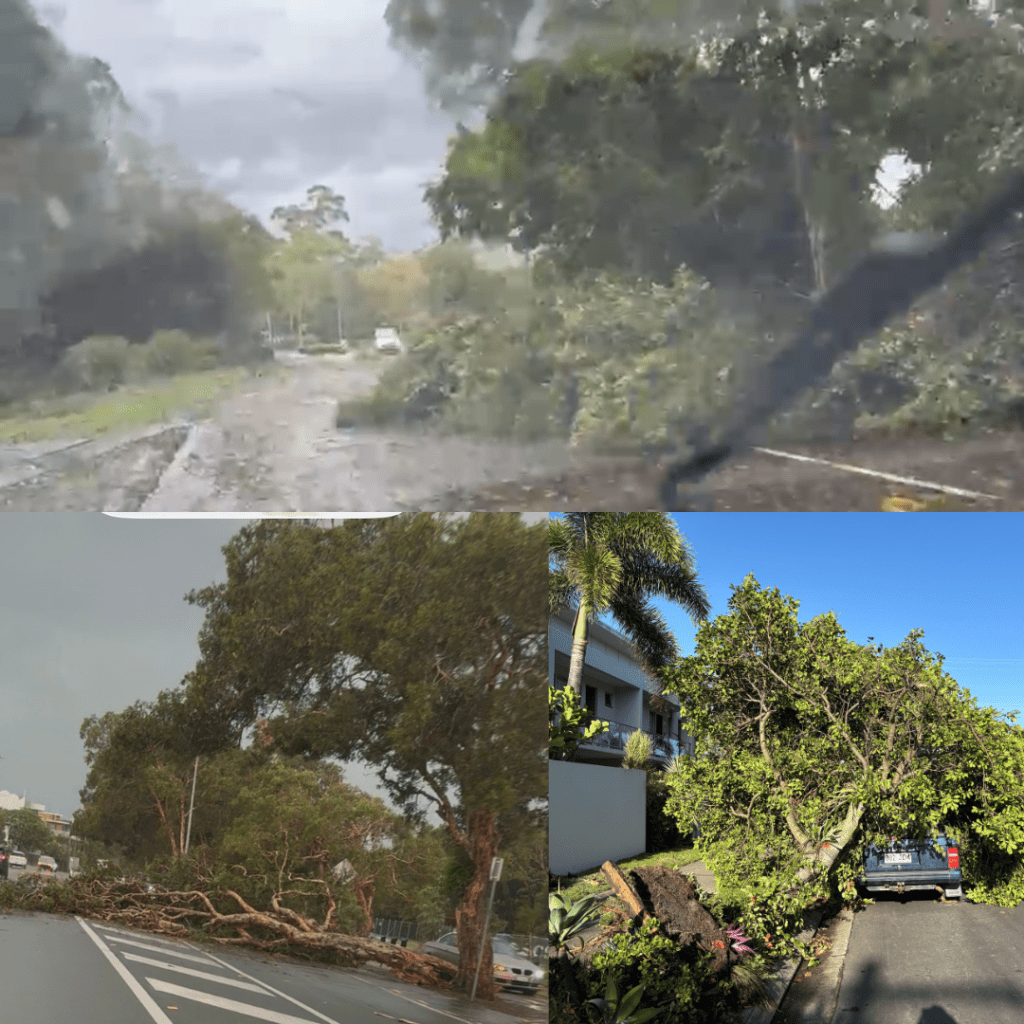
So it was interesting when a surprise storm hit my little town with winds of 150+ km per hour, felling entire trees, launching our balcony furniture 200 metres away into a neighbour’s yard, peeling our roof back, and picking up my large potted tree and dumping it 10 metres away as though it was flotsam.

I was out at a local appointment, and once the lightning stopped began to make my way through the debris, scattered shop signs and collapsed trees blocking the roads. My husband said at one point our windows were so buckled inwards with the force of the wind that he was certain they would give way. (Oh the irony after all our preparations earlier this year with the massive cyclone that never eventuated.)

Once the wind and rain had subsided, we began cleaning up the mess.

But it’s a different aftermath that was perhaps more disturbing. 

We lost power, NBN and all communications for two days in my street, others for one or three days. 

My first thought was how unsafe I felt without a phone, radio or satellite to use in an emergency or just to check if my nearby family were safe. Unless you have a satellite, everything else is digital these days, so when the network goes, everything goes. How vulnerable we’ve made ourselves.

My second thought was that because I work 100% online I was unable do that, or in other words, I couldn’t earn a living. I had to drive half and hour away to cancel and rebook consults. Not much of a disaster in the scheme of things, but given so many of us work from home I understood how this could become a greater problem in the future. 

This leads me to my third realisation, which was that more frequent and unexpected weather events is the new normal, and that I needed to be more prepared. Climate change is real now, and I need a sat phone, better emergency rations and cooking gear. We already have a solar battery, which kept our lights on and food cold, plenty of stored water, and I have a first aid kit and updated training.

And then, somewhat shamefully – and even more alarming – was the observation of how irritable, bored and empty I felt after 12 hours of not having instant access to everything I normally entertained and calmed myself with, from social media, games and streaming to the ability to message my family and friends. 

How had I lived happily for years without these props and fillers? How had a shared free-to-air TV, books, pen and paper, music, a landline, and the odd hobby ever been enough?

While this seems petty given the bigger issues of climate change, safety and my ability to earn money, the loss of communications brought home to me how modern technology had changed my brain. I was ashamed to admit that I too had become addicted, craving the next dopamine hit, and using it as a crutch to fill my quieter moments and block out the the stuff of life I’d rather not face.

So what is missing from my life that I was drawn to this addiction? What must I now rebuild and replenish?

I thought about this long and hard and decided that for me, creativity is the antithesis and antidote to the mind-numbing hypnosis of modern technology. Instant entertainment is self-fulfilling vicious cycle that numbs me out while making me want more of it to rouse my emotions and lift me up again. My former overuse is a pleasure-seeking road to hollowness. We cannot eat sugar all day and expect no consequences.

I’m already reading more books, I’m planning my next novel and restarting this blog (without the use of AI), I don’t check my social media often. In fact, I’m toying with getting rid of my social media accounts altogether but … business. I also ensure I sit in silence for 10 minutes every day, walk more without my phone, and if I feel bored, I welcome it and see what revelation or idea might surface.

What about you and our instant online life?

Make your text come alive with verbs & nouns

Verbs and nouns are the cornerstones of vivid, impactful writing. When chosen deliberately, they provide a direct, tangible connection between the writer’s imagination and the reader’s experience.

I learned this after doing a short course, and it’s probably the most valuable writing lesson I learned. At the time, I was struggling to make my text more impactful in line with my dramatic storyline.

Part of the reason verbs and nouns work so well is that they avoid the need for wordy and repetitive adverbs and adjectives. Then, when you do decide to use them, they have a greater impact.

Why verbs & nouns are vital

  1. Verbs drive action
    • Verbs create movement and momentum in the narrative. They signal what’s happening, transforming static description into dynamic scenes, drawing the reader in and holding their attention
    • For example, compare “The dog was in the yard” (static) with “The dog launched itself across the yard” (dynamic)
    • Strong, precise verbs eliminate the need for excessive modifiers like adverbs, and they streamline prose, maintaining energy
  2. Nouns anchor reality
    • Nouns on the other hand, ground the reader in the sensory world, offering specificity and detail
    • For example, “Tree” is a generic noun, but “oak” or “willow” conjures a precise image, enhancing the reader’s experience
    • Specific nouns evoke emotions and associations. Consider the difference between “a chair”and “an antique rocking chair”
  3. Engage the reader’s imagination
    • Vibrant verbs and specific nouns invite readers to visualise, hear and feel the scene
    • For example, “The waves crashed against jagged rocks” engages sight, sound and motion, while “The waves were loud” falls flat

How to use verbs & nouns effectively

  1. Choose precise verbs
    • Avoid generic verbs like “is,” “have,” and “go.” Replace them with more vivid alternatives
    • For example, replace “The car went down the road” with “The car zoomed down the road”
  2. Opt for concrete nouns
    • Use nouns that evoke clear, tangible imagery
    • For example, instead of “fruit,” say “juicy pomegranate” or “ripe mango”
  3. Balance action with description
    • Verbs and nouns should complement each other. A powerful verb paired with a weak noun loses impact, and vice versa
    • For example, “The child stumbled on the cobblestones” is stronger than “The person walked on the path”
  4. Avoid overloading with adjectives and adverbs
    • Strong verbs and nouns often eliminate the need for extra description
    • For example, “He sprinted” is more effective than “He ran quickly”

What this achieves

  1. Immersive experiences
    • Readers can see and feel the action, making the text resonate emotionally
  2. Rhythmic flow
    • Strong verbs and nouns create a cadence in the prose, drawing readers forward effortlessly.
  3. Memorable imagery
    • Specific nouns and verbs linger in the reader’s mind, making the text unforgettable
  4. Reader engagement
    • Action-packed, sensory-rich sentences hold attention and invite deeper connection

Examples

Weak The man was in a hurry as he went through the forest, looking at the trees.
Stronger The man dashed through the forest, scanning the towering pines.

Weak The cat was on the roof, making noise.
Stronger The cat yowled atop the tin roof.

By deliberately crafting sentences with vibrant verbs and evocative nouns, your writing can leap off the page and pull readers into a living, breathing world.