Australia’s strategic future if not with the US

For some of us, the Trump administration’s accruing aberrant actions have affirmed that the US is now a rogue state. Many say it has been for years, stealing oil from Iraq, African nations, and now Venezuela; abusing human rights and orchestrating regime change in Latin America and the Middle East where left-leaning or non-aligned governments nationalised natural resources; and interfering in domestic politics, usually towards the right, and possibly including the dismissal of Prime Minster Gough Whitlam.

If you’re wondering what a rogue state is there’s no official definition, but there are some typical characteristics. These include a disregard for international law, perpetrating human rights violations, authoritarian rule, recklessness, and the pursuit of weapons of mass destruction. 

You could also argue other signs of the US going rogue include its deliberate destabilisation of the world economic order with the introduction of unlawful tariffs, aggressive technological domination and manipulation, and even a lack of action on global warming. Then there’s America’s dubious relationship with Russia, which by its own admission is conducting a cyber cold war, and increasingly a physical one against the West, especially Europe. 

Holding similar concerns and in a first, Denmark recently described the US as a potential security threat due to its use of economic and military coercion, along with its desire to subjugate Greenland for its rich natural resources. Additionally, the UK has stopped sharing intelligence with the US on the Caribbean under the Five Eyes alliance because it’s concerned about breaching international law and ending up in the International Criminal Court.

While historically it suited the West to turn a blind eye to America’s abuses because we shared similar values and they were a powerful strategic ally that did some of our dirty work, this is no longer the case. The US does not pretend to be values driven these days, nor does it demonstrate respect for hard fought for and valued institutions, or its allies.

Where does that leave Australia, a middle power that’s fought alongside the US in every war, from WW2 to Korea, Iraq and more?

You could argue that Trump will not be in power forever and things will soon return to a new normal. However, the US can’t go back, and neither can the world. American behaviours have set dangerous precedents, paving the way for other countries to also misbehave without punitive consequences. 

For Australia, we should never place such heavy reliance on a single ally again. In 2022 Labor said about the US that we will “cooperate where we can, disagree where we must, and engage in the national interest”. We need to be more proactive than this now. 

Yet, Australian foreign policy appears to remain “All the way with LBJ” (a declaration made by Prime Minster Holt to President Lydon B Johnson in the 1970s symbolising Australia’s strong commitment to the US alliance during the Cold and Vietnam wars). In fact, the Labor government continues to describe the US as our “principal strategic partner and ally”.

In that vein, Defence Secretary Hegseth just announced that the US will be upgrading infrastructure and logistics in the Northern Territory, Queensland, and across Australia to allow for additional US bomber rotations, deployments, and pre-positioning. 

There was no discussion around whether the US can be trusted to behave responsibly in the Asia-Pacific region, and in line with Australian national interests. This is questionable with regards to China. Australia was the first Western nation to build bridges with, and visit China in the 1970s, with the US following. We did this because we’re part of the Asia-Pacific region and foresaw the rise of China. Australian sovereignty concerns aside, this expansion might make us a greater target for a China that one day wants to hurt the US. As we’ve seen before, the US likes to deflect wars offshore too.

Australia has also recently signed an agreement on the supply and processing of critical minerals and rare earths to the US aimed at reducing reliance on China. There’s been no thought given to the serious environmental impact such mining is reported to have, with Foreign Minister Wong stating that “the US relationship matters more than some domestic politics about environmental reform”. It’s revealing that the environment is not seen by Labor (or Liberal) as a serious matter threatening the viability of our shared planet, all nations, and life itself. It has done little in this area. Of note, tariffs against Australia persist, and threats of more such as the 100% one on our film industry continue. 

So where should Australia look for alliances as a middle power that is neither Asian but multicultural by identity, nor European in location?

Despite that we’ve seen how, like the US, China can wield economic coercion and trade blockages against us, we need to continue to build that relationship. As a former diplomat posted to Jakarta, East Timor and New Zealand, I understand Australia’s sway, or sometimes lack of, in the region. We do matter, and we have natural resources China needs. We must strengthen real ties with China and the region across the board.

On that note, our relationship with India as an emerging power with similar interests needs to develop, including in strategic and defence cooperation, trade and investment, agriculture and water, and education. 

Then there are our existing ties with other UCANZA members, namely Canada, the UK and New Zealand, that can be directly strengthened where gaps appear at the bilateral level, for example in critical minerals, defence, and non-tariff barriers. 

For some time now, China has been busy undercutting our relationships in the Indo-Pacific, so we need to put more time and money into those relationships. And while Europe is a long way away, we share a rules-based world order view. Opportunities must be explored on strategic cooperation in security, the green energy transition, research and innovation, and trade diversification.

If, as it’s said, Trump thrives on the caution and ineptitude of his opponents, Australia needs to stand up for itself, in its own national interest for the Australian people, and not subordinate our values, priorities and region. 

After the storm in the Sunny Coast

Most nights from my 3rd-storey bedroom window in my semi-rural Sunshine Coast home, I look out and see a strangely long and exceedingly bright star. Except it isn’t a star – it’s reputedly Elon Musk’s satellite.

From the moment I learned this I felt watched over, as if I didn’t already know that feeling from the devices and apps I’m aware track my movements, opinions, conversations, shopping habits and more.

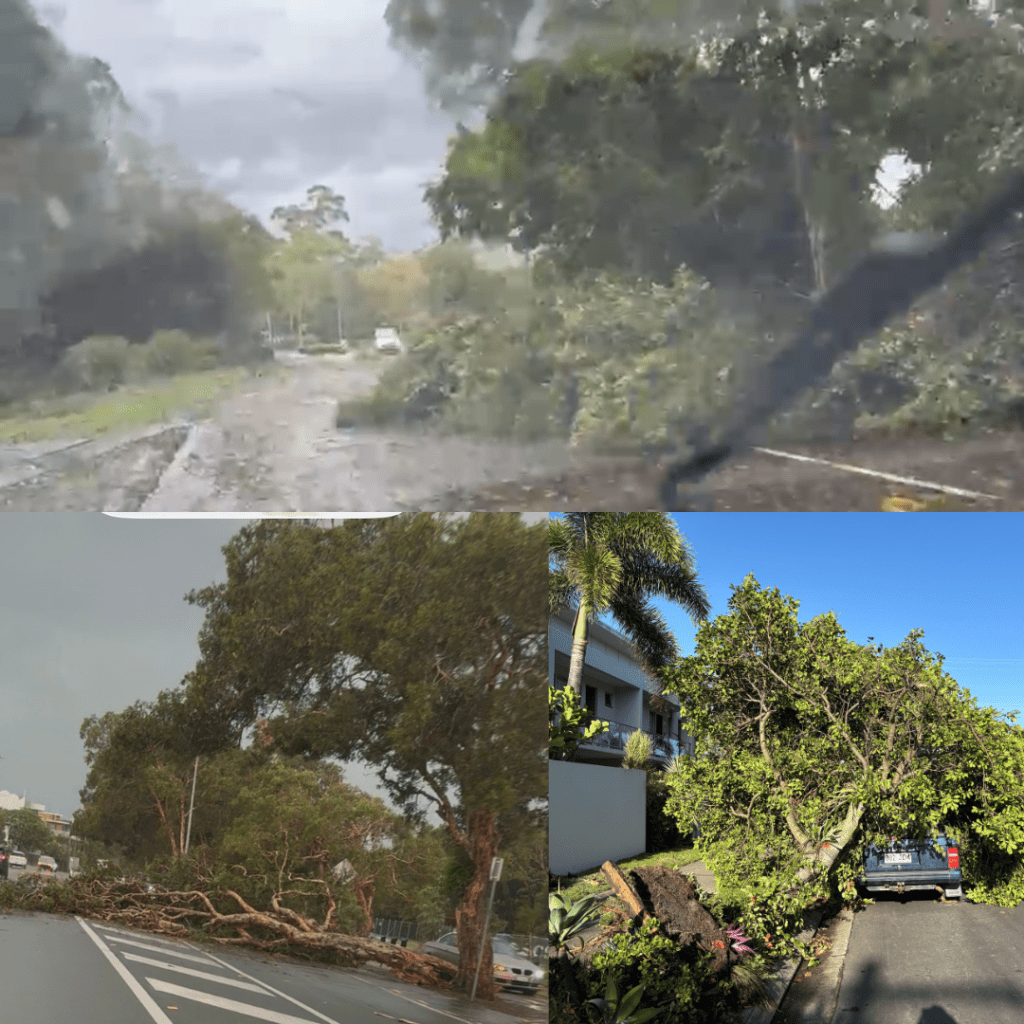
So it was interesting when a surprise storm hit my little town with winds of 150+ km per hour, felling entire trees, launching our balcony furniture 200 metres away into a neighbour’s yard, peeling our roof back, and picking up my large potted tree and dumping it 10 metres away as though it was flotsam.

I was out at a local appointment, and once the lightning stopped began to make my way through the debris, scattered shop signs and collapsed trees blocking the roads. My husband said at one point our windows were so buckled inwards with the force of the wind that he was certain they would give way. (Oh the irony after all our preparations earlier this year with the massive cyclone that never eventuated.)

Once the wind and rain had subsided, we began cleaning up the mess.

But it’s a different aftermath that was perhaps more disturbing. 

We lost power, NBN and all communications for two days in my street, others for one or three days. 

My first thought was how unsafe I felt without a phone, radio or satellite to use in an emergency or just to check if my nearby family were safe. Unless you have a satellite, everything else is digital these days, so when the network goes, everything goes. How vulnerable we’ve made ourselves.

My second thought was that because I work 100% online I was unable do that, or in other words, I couldn’t earn a living. I had to drive half and hour away to cancel and rebook consults. Not much of a disaster in the scheme of things, but given so many of us work from home I understood how this could become a greater problem in the future. 

This leads me to my third realisation, which was that more frequent and unexpected weather events is the new normal, and that I needed to be more prepared. Climate change is real now, and I need a sat phone, better emergency rations and cooking gear. We already have a solar battery, which kept our lights on and food cold, plenty of stored water, and I have a first aid kit and updated training.

And then, somewhat shamefully – and even more alarming – was the observation of how irritable, bored and empty I felt after 12 hours of not having instant access to everything I normally entertained and calmed myself with, from social media, games and streaming to the ability to message my family and friends. 

How had I lived happily for years without these props and fillers? How had a shared free-to-air TV, books, pen and paper, music, a landline, and the odd hobby ever been enough?

While this seems petty given the bigger issues of climate change, safety and my ability to earn money, the loss of communications brought home to me how modern technology had changed my brain. I was ashamed to admit that I too had become addicted, craving the next dopamine hit, and using it as a crutch to fill my quieter moments and block out the the stuff of life I’d rather not face.

So what is missing from my life that I was drawn to this addiction? What must I now rebuild and replenish?

I thought about this long and hard and decided that for me, creativity is the antithesis and antidote to the mind-numbing hypnosis of modern technology. Instant entertainment is self-fulfilling vicious cycle that numbs me out while making me want more of it to rouse my emotions and lift me up again. My former overuse is a pleasure-seeking road to hollowness. We cannot eat sugar all day and expect no consequences.

I’m already reading more books, I’m planning my next novel and restarting this blog (without the use of AI), I don’t check my social media often. In fact, I’m toying with getting rid of my social media accounts altogether but … business. I also ensure I sit in silence for 10 minutes every day, walk more without my phone, and if I feel bored, I welcome it and see what revelation or idea might surface.

What about you and our instant online life?

Make your text come alive with verbs & nouns

Verbs and nouns are the cornerstones of vivid, impactful writing. When chosen deliberately, they provide a direct, tangible connection between the writer’s imagination and the reader’s experience.

I learned this after doing a short course, and it’s probably the most valuable writing lesson I learned. At the time, I was struggling to make my text more impactful in line with my dramatic storyline.

Part of the reason verbs and nouns work so well is that they avoid the need for wordy and repetitive adverbs and adjectives. Then, when you do decide to use them, they have a greater impact.

Why verbs & nouns are vital

  1. Verbs drive action
    • Verbs create movement and momentum in the narrative. They signal what’s happening, transforming static description into dynamic scenes, drawing the reader in and holding their attention
    • For example, compare “The dog was in the yard” (static) with “The dog launched itself across the yard” (dynamic)
    • Strong, precise verbs eliminate the need for excessive modifiers like adverbs, and they streamline prose, maintaining energy
  2. Nouns anchor reality
    • Nouns on the other hand, ground the reader in the sensory world, offering specificity and detail
    • For example, “Tree” is a generic noun, but “oak” or “willow” conjures a precise image, enhancing the reader’s experience
    • Specific nouns evoke emotions and associations. Consider the difference between “a chair”and “an antique rocking chair”
  3. Engage the reader’s imagination
    • Vibrant verbs and specific nouns invite readers to visualise, hear and feel the scene
    • For example, “The waves crashed against jagged rocks” engages sight, sound and motion, while “The waves were loud” falls flat

How to use verbs & nouns effectively

  1. Choose precise verbs
    • Avoid generic verbs like “is,” “have,” and “go.” Replace them with more vivid alternatives
    • For example, replace “The car went down the road” with “The car zoomed down the road”
  2. Opt for concrete nouns
    • Use nouns that evoke clear, tangible imagery
    • For example, instead of “fruit,” say “juicy pomegranate” or “ripe mango”
  3. Balance action with description
    • Verbs and nouns should complement each other. A powerful verb paired with a weak noun loses impact, and vice versa
    • For example, “The child stumbled on the cobblestones” is stronger than “The person walked on the path”
  4. Avoid overloading with adjectives and adverbs
    • Strong verbs and nouns often eliminate the need for extra description
    • For example, “He sprinted” is more effective than “He ran quickly”

What this achieves

  1. Immersive experiences
    • Readers can see and feel the action, making the text resonate emotionally
  2. Rhythmic flow
    • Strong verbs and nouns create a cadence in the prose, drawing readers forward effortlessly.
  3. Memorable imagery
    • Specific nouns and verbs linger in the reader’s mind, making the text unforgettable
  4. Reader engagement
    • Action-packed, sensory-rich sentences hold attention and invite deeper connection

Examples

Weak The man was in a hurry as he went through the forest, looking at the trees.
Stronger The man dashed through the forest, scanning the towering pines.

Weak The cat was on the roof, making noise.
Stronger The cat yowled atop the tin roof.

By deliberately crafting sentences with vibrant verbs and evocative nouns, your writing can leap off the page and pull readers into a living, breathing world.

From boredom to creativity

When you have lots to do, do nothing, feel bad about it, but out pops something really creative, you realise that sometimes creativity requires boredom, restlessness and doing nothing because in the background, your brain needs the space to come up with something new.

Trust your processes, creators.

Find out more about Gunfire Lullabies, writing and me in these podcasts, interviews and features!

The Empty Page podcast

Find out about my writing and publishing process for Gunfire Lullabies? Click here to hear my interview with Gavin Miller and The Empty Page podcast. Lots of fun.

Talking Aussie Book podcast

Learn more about the origin of Gunfire Lullabies on this podcast interview I did with Claudine Tinellis on Taking Aussie Books. Great in depth questions.

Ten Terrifying Questions with Booktopia

Booktopia asked me Ten Terrifying Questions revealing more about the person behind the novel. Check it out here.

AJC Publishing Author Interview

Read a different angle on Gunfire Lullabies and my writing process here.

The Australian Financial Review Weekend story

I wrote a piece for the Fin Review charting my journey from diplomat to novelist. Read it here.

For more interviews, check out my media page!

Just click here 🙂

Writing – Should you pick up where you left off or start over?

My second novel is 40,000 words in. I began writing it in 2010, and since then have added sections in spurts, mainly in 2017.

In 2022, 11 years on and 5 years since I last added anything significant, I’m determined to finish a solid first draft.

But should I start again?

An old friend of mine wrote an award-winning novel in two parts, and they read very differently. I liked the second half much more than the first, and didn’t feel it worked to have two markedly varied styles in the same book (yet clearly others didn’t mind).

Some things I’m considering:

  • My writing has evolved, significantly improving since 2010 and 2017 (you’d hope so!)
  • While the story line is the same, the theme has deepened to consider current events
  • I was never happy with the voice of the main child character. For me, voice takes several drafts to get right, so this may not require me to start over. Hmm…
  • Yet I also feel I know the main character better, who is inspired by my parents and some of their experiences during WW2
  • I’m wondering if I should change the point of view to more authorial, from one person to two or more. But this has always been a dilemma I’ve needed to act on
  • It’s a bit of a mess because I’ve written it in fits and starts

I think the answer is clear for me. I need to ditch the other work out and begin again. I also did this with my published novel, Gunfire Lullabies, which I wrote in three very different drafts. This came to me after having heard about process writing The Narrow Road to the Deep North, which I still thought was quite fractured.

My main reason?

  • The theme – The other aspects I can correct with some rewriting / editing, but having an altered theme changes everything – syntax, style, plot, point of view and character even, as I now want them to represent something additional

What’s your experience of picking up a story you’ve partly finished?