Australia’s strategic future if not with the US

For some of us, the Trump administration’s accruing aberrant actions have affirmed that the US is now a rogue state. Many say it has been for years, stealing oil from Iraq, African nations, and now Venezuela; abusing human rights and orchestrating regime change in Latin America and the Middle East where left-leaning or non-aligned governments nationalised natural resources; and interfering in domestic politics, usually towards the right, and possibly including the dismissal of Prime Minster Gough Whitlam.

If you’re wondering what a rogue state is there’s no official definition, but there are some typical characteristics. These include a disregard for international law, perpetrating human rights violations, authoritarian rule, recklessness, and the pursuit of weapons of mass destruction. 

You could also argue other signs of the US going rogue include its deliberate destabilisation of the world economic order with the introduction of unlawful tariffs, aggressive technological domination and manipulation, and even a lack of action on global warming. Then there’s America’s dubious relationship with Russia, which by its own admission is conducting a cyber cold war, and increasingly a physical one against the West, especially Europe. 

Holding similar concerns and in a first, Denmark recently described the US as a potential security threat due to its use of economic and military coercion, along with its desire to subjugate Greenland for its rich natural resources. Additionally, the UK has stopped sharing intelligence with the US on the Caribbean under the Five Eyes alliance because it’s concerned about breaching international law and ending up in the International Criminal Court.

While historically it suited the West to turn a blind eye to America’s abuses because we shared similar values and they were a powerful strategic ally that did some of our dirty work, this is no longer the case. The US does not pretend to be values driven these days, nor does it demonstrate respect for hard fought for and valued institutions, or its allies.

Where does that leave Australia, a middle power that’s fought alongside the US in every war, from WW2 to Korea, Iraq and more?

You could argue that Trump will not be in power forever and things will soon return to a new normal. However, the US can’t go back, and neither can the world. American behaviours have set dangerous precedents, paving the way for other countries to also misbehave without punitive consequences. 

For Australia, we should never place such heavy reliance on a single ally again. In 2022 Labor said about the US that we will “cooperate where we can, disagree where we must, and engage in the national interest”. We need to be more proactive than this now. 

Yet, Australian foreign policy appears to remain “All the way with LBJ” (a declaration made by Prime Minster Holt to President Lydon B Johnson in the 1970s symbolising Australia’s strong commitment to the US alliance during the Cold and Vietnam wars). In fact, the Labor government continues to describe the US as our “principal strategic partner and ally”.

In that vein, Defence Secretary Hegseth just announced that the US will be upgrading infrastructure and logistics in the Northern Territory, Queensland, and across Australia to allow for additional US bomber rotations, deployments, and pre-positioning. 

There was no discussion around whether the US can be trusted to behave responsibly in the Asia-Pacific region, and in line with Australian national interests. This is questionable with regards to China. Australia was the first Western nation to build bridges with, and visit China in the 1970s, with the US following. We did this because we’re part of the Asia-Pacific region and foresaw the rise of China. Australian sovereignty concerns aside, this expansion might make us a greater target for a China that one day wants to hurt the US. As we’ve seen before, the US likes to deflect wars offshore too.

Australia has also recently signed an agreement on the supply and processing of critical minerals and rare earths to the US aimed at reducing reliance on China. There’s been no thought given to the serious environmental impact such mining is reported to have, with Foreign Minister Wong stating that “the US relationship matters more than some domestic politics about environmental reform”. It’s revealing that the environment is not seen by Labor (or Liberal) as a serious matter threatening the viability of our shared planet, all nations, and life itself. It has done little in this area. Of note, tariffs against Australia persist, and threats of more such as the 100% one on our film industry continue. 

So where should Australia look for alliances as a middle power that is neither Asian but multicultural by identity, nor European in location?

Despite that we’ve seen how, like the US, China can wield economic coercion and trade blockages against us, we need to continue to build that relationship. As a former diplomat posted to Jakarta, East Timor and New Zealand, I understand Australia’s sway, or sometimes lack of, in the region. We do matter, and we have natural resources China needs. We must strengthen real ties with China and the region across the board.

On that note, our relationship with India as an emerging power with similar interests needs to develop, including in strategic and defence cooperation, trade and investment, agriculture and water, and education. 

Then there are our existing ties with other UCANZA members, namely Canada, the UK and New Zealand, that can be directly strengthened where gaps appear at the bilateral level, for example in critical minerals, defence, and non-tariff barriers. 

For some time now, China has been busy undercutting our relationships in the Indo-Pacific, so we need to put more time and money into those relationships. And while Europe is a long way away, we share a rules-based world order view. Opportunities must be explored on strategic cooperation in security, the green energy transition, research and innovation, and trade diversification.

If, as it’s said, Trump thrives on the caution and ineptitude of his opponents, Australia needs to stand up for itself, in its own national interest for the Australian people, and not subordinate our values, priorities and region. 

After the storm in the Sunny Coast

Most nights from my 3rd-storey bedroom window in my semi-rural Sunshine Coast home, I look out and see a strangely long and exceedingly bright star. Except it isn’t a star – it’s reputedly Elon Musk’s satellite.

From the moment I learned this I felt watched over, as if I didn’t already know that feeling from the devices and apps I’m aware track my movements, opinions, conversations, shopping habits and more.

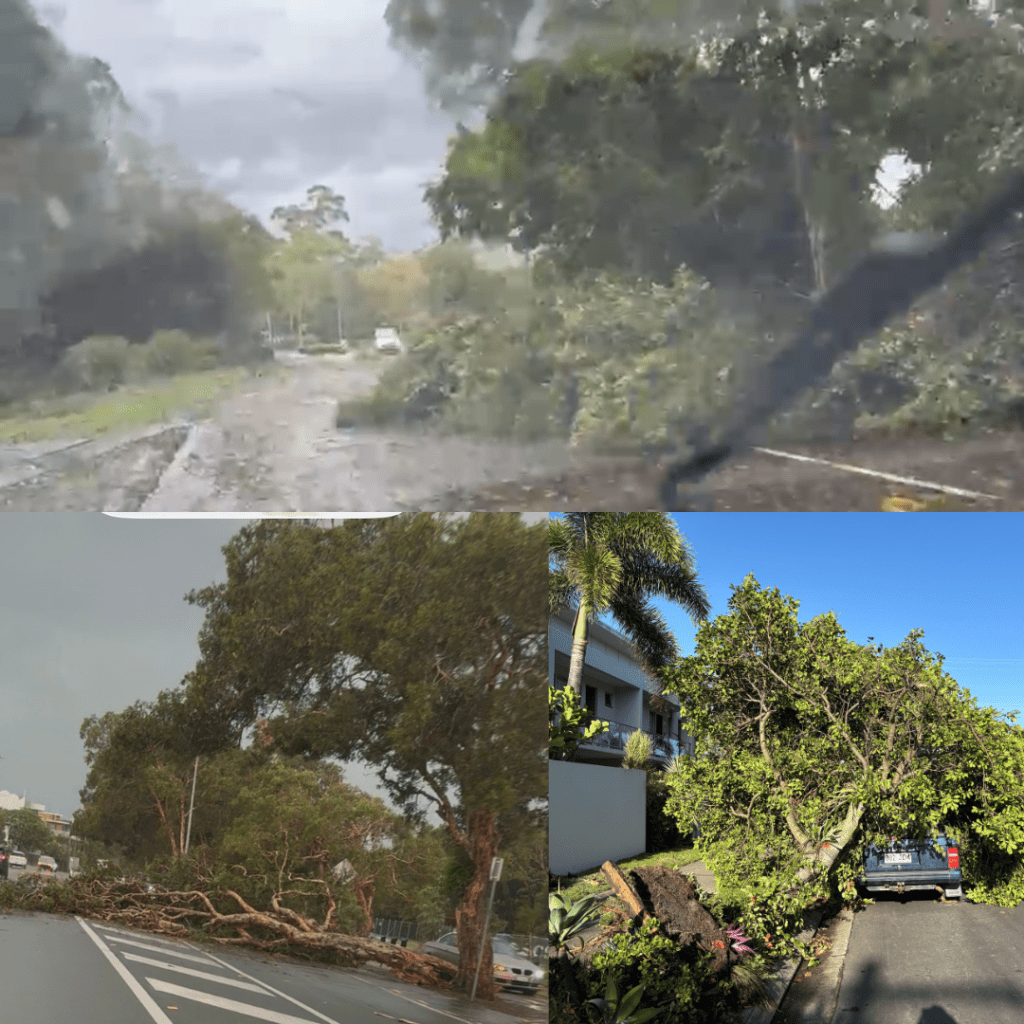
So it was interesting when a surprise storm hit my little town with winds of 150+ km per hour, felling entire trees, launching our balcony furniture 200 metres away into a neighbour’s yard, peeling our roof back, and picking up my large potted tree and dumping it 10 metres away as though it was flotsam.

I was out at a local appointment, and once the lightning stopped began to make my way through the debris, scattered shop signs and collapsed trees blocking the roads. My husband said at one point our windows were so buckled inwards with the force of the wind that he was certain they would give way. (Oh the irony after all our preparations earlier this year with the massive cyclone that never eventuated.)

Once the wind and rain had subsided, we began cleaning up the mess.

But it’s a different aftermath that was perhaps more disturbing. 

We lost power, NBN and all communications for two days in my street, others for one or three days. 

My first thought was how unsafe I felt without a phone, radio or satellite to use in an emergency or just to check if my nearby family were safe. Unless you have a satellite, everything else is digital these days, so when the network goes, everything goes. How vulnerable we’ve made ourselves.

My second thought was that because I work 100% online I was unable do that, or in other words, I couldn’t earn a living. I had to drive half and hour away to cancel and rebook consults. Not much of a disaster in the scheme of things, but given so many of us work from home I understood how this could become a greater problem in the future. 

This leads me to my third realisation, which was that more frequent and unexpected weather events is the new normal, and that I needed to be more prepared. Climate change is real now, and I need a sat phone, better emergency rations and cooking gear. We already have a solar battery, which kept our lights on and food cold, plenty of stored water, and I have a first aid kit and updated training.

And then, somewhat shamefully – and even more alarming – was the observation of how irritable, bored and empty I felt after 12 hours of not having instant access to everything I normally entertained and calmed myself with, from social media, games and streaming to the ability to message my family and friends. 

How had I lived happily for years without these props and fillers? How had a shared free-to-air TV, books, pen and paper, music, a landline, and the odd hobby ever been enough?

While this seems petty given the bigger issues of climate change, safety and my ability to earn money, the loss of communications brought home to me how modern technology had changed my brain. I was ashamed to admit that I too had become addicted, craving the next dopamine hit, and using it as a crutch to fill my quieter moments and block out the the stuff of life I’d rather not face.

So what is missing from my life that I was drawn to this addiction? What must I now rebuild and replenish?

I thought about this long and hard and decided that for me, creativity is the antithesis and antidote to the mind-numbing hypnosis of modern technology. Instant entertainment is self-fulfilling vicious cycle that numbs me out while making me want more of it to rouse my emotions and lift me up again. My former overuse is a pleasure-seeking road to hollowness. We cannot eat sugar all day and expect no consequences.

I’m already reading more books, I’m planning my next novel and restarting this blog (without the use of AI), I don’t check my social media often. In fact, I’m toying with getting rid of my social media accounts altogether but … business. I also ensure I sit in silence for 10 minutes every day, walk more without my phone, and if I feel bored, I welcome it and see what revelation or idea might surface.

What about you and our instant online life?

Australia, who are you?

AdobeStock_231227507.jpeg

I heard a story the other day from someone traveling through Europe.

When asked by a local what nationality they were, this person replied ‘Australian’.The European turned their back on them and walked away. The traveller said this was the first time they had experienced this. Normally as an Australian they were welcomed with open arms.

The other experience I had was at a networking event filled with small business people from diverse cultural backgrounds. I’m a first generation Australian as were quite a few others. A couple were also new immigrants.

This, I thought, is more like real Australia, not like the white, middle class and middle aged men you see on TV.

‘Best country in the world, Australia,’ two of these men insisted.

‘Is it?’ I wondered. It should be. We’ve been so lucky in many ways.

But rather, I feel shame at being a member of a selfish country that doesn’t care about its poor or homeless, the refugees who legally apply for asylum, the climate that is so obviously changing every year, our animals and plants in distress and decline, the little native bush we have left that’s readily given over to poor farming practices, indigenous Australians’ rights, people with different views, privacy, freedom of speech, freedom of choice over mainstream and alternative medicine, supporting developing countries, public education, women, jobs or the rest of the world except maybe for America.

That’s not quite true. We sort of care. But not enough to do something about these things if it means possibly going against our personal interests.

Instead we are a country that voted against a non-existent death tax, and for share franking to continue when we either had no shares, or because we believed we had a right to avoid paying tax on them so we could give our superannuation to our kids. This is the superannuation already taxed at very low levels to allow for self-funded retirement, thus taking the burden off the state. Me me me over eduction, affordable housing, the economy, infrastructure and aid.

Our identity is as a laid back fair go kind of place. What sort of backbone is that? In any case, there isn’t much that’s fair out there in real Australia, even if there are a million and one rules. We are sexist, ageist, racist and we don’t give a damn about people less well off. I understand the world feels more dog eat dog. I feel it too. But where is the national character in us that says ‘This is not right’? Where is the leader who stands up and is willing to make constructive changes for our future, even if it makes us feel a little uncomfortable? Change is growth and growth can be uncomfortable. Rather, we’re content to tread water and drift backwards.

Australia, I feel, is also a country that reacts with fear rather than finding the courage to follow a vision. In truth, we have no vision. We’d rather knock that down, continuing our unhealthy tall poppy tradition. So we roll over on the things we don’t like and shrug saying ‘Nothing I can do about it’ or ‘I don’t follow politics’. Must protect the status quo.

We have no Magna Carta equivalent and I think we need one that also considers the rights of our first inhabitants. If we properly address our past, we might be better able to build our future. From this process we can forge a stronger identity and define values to guide us during these challenging times.

I used to feel proud in East Timor of the job our soldiers did. I used to feel proud as a diplomat to put forward certain values, politics aside. I’m glad I don’t have to do that now because I couldn’t do it and sleep at night. Compartmentalisation can only go so far.

But getting back to my initial story, while I don’t fully know why the European turned away from the Australian, in my heart of hearts I do. I suspect they might see us as a lucky, spoilt young country that refuses to grow up and be responsible.

And if this was the case, I would agree.

[Before you tell me to go back to where I came from (even though I was born here), I’m writing this because I care. Not because I don’t.]

The courage to write opinions

'Courage is not the absence of fear, but rather the judgement that something else is more important than fear.' Ambrose Redmoon.png

Hi everyone

My blogs have, until recently, been all about writing.

With the publication of my debut novel in August, I’ve decided to change tack and write some opinion pieces.

You may have seen my piece about Anzac Day, which stirred up strong feelings as many of us have relatives who are or have been involved in wars, or indeed may have experienced them ourselves.

Some of my new blogs will be opinion pieces on topics I feel strongly about. Hence the quote about courage, because some of it will be close to the bone. Gulp. I don’t know if anyone will be interested in reading them, but it’s important for me to write them.

Others will continue to be about writing. For example, I plan to write about the what the editing process is like from the inside.

Keep on writing. Keep on reading. Keep on thinking you creatives and thinkers. Never, ever give up. 

Nore xo