
Perhaps you’re disappointed at not being published, or you self-published but the sales weren’t great, or you’ve been plugging away for so long without ‘success’ that you’re having doubts about this writing thing, or the words that come out on the page aren’t the ones you feel inside, or you’ve simply lost sight of why you’re writing.
The result is that you can’t seem to find your enthusiasm for writing anymore. It used to excite you to sit down at a blank page, it was fun. But now all you feel is dread. You start avoiding it or you procrastinate or you talk yourself out of it. Maybe you’ve given up entirely, or if you do manage to force yourself to write it feels like a chore, another obligation in your long list for the day.
What’s happened to make you feel this way?
Writing has become a negative experience
Whatever the reason, the end result is that writing makes you feel bad. Most likely, you’ve also lost confidence in yourself and your writing along the way. So why would you write if that’s how it makes you feel?
You need to get back to what you enjoy about writing to shift it back into a positive experience. Here are some ideas on how to do this.
If you did and you haven’t met your goal, then no wonder you feel like a failure. You’ve set yourself up with unrealistic expectations. Need I remind you that writing is hard, really hard.
Let go or detach from your goals and become zen about your writing. Enjoy the moment, enjoy the writing or the process rather than focusing on the outcome. The result is a side benefit, not the primary aim of writing. Loving doing your best writing is the only true goal. See what happens.
On the other hand, if you’ve dug deep and can’t find any reasons why you should continue to write, perhaps it is time to give it up. But if that thought fills you with horror and a list of ‘buts I can’t because…’, then you have your answer. Read your list of why you want to write every time you meet the blank page, and watch your self-belief slowly return.
When we write, we’re not in a life or death situation. So next time that doubting, fearful, critical voice tells you something bad about you and your writing, try acknowledging what it has to say, thanking it for its concern and then telling it you’re not going to follow its advice today as there really isn’t any need. Then get on with your work. Remember, you control your thoughts. Don’t let them take control of you.
This seems like a lot of hard work for something you once believed would flow easily from you via some muse. For most of us such a muse is a myth. The muse is really you delving deep into yourself without fear of consequence or expectation of reward and creating (more on how to do that here). Set up the best writing environment possible and you might be surprised at what turns up on your page.
Perhaps you’re at breakdown, at crisis point? Perhaps a breakthrough is just around the corner. Success (meaning growth) depends on perseverance, which is resilience in the face of failure and adversity. If you give up now, you may never know. You have a choice. Over to you and the best of luck.


So you’ve completed your manuscript. Before you send it off to publishers, make sure it’s the best it can be. Not just the best it can be right now, but best FULL STOP. Often we get impatient and send our manuscripts out into the world too early when we should put them away for a couple of months before reviewing them again, send them off to a professional for an assessment or do yet another draft. But let’s say you’ve done all that and your book is the best it can be. You truly believe in it.
You compile a list of publishers and you send it to them. You’ve spent the time you need to write each personalised letter, hone your pitch, nail your marketing strategy, write gripping synopses of varying lengths and a fascinating author bio. Off your MS goes into the wilderness (with a touch of that true belief).
Now you wait. Perhaps you get bites for more of your MS. Perhaps you succeed quickly – someone wants to publish your book. Yay you. Congratulations! But if you’re one of the majority who either hear nothing back (“assume if you haven’t heard from us within three months that we’re not interested”) or get outright rejections, then what?
The important thing is not to be beaten in the process of getting published. You may view not finding a traditional publisher as failure, but failure is simply another form of feedback. Use it wisely and keep moving ahead.
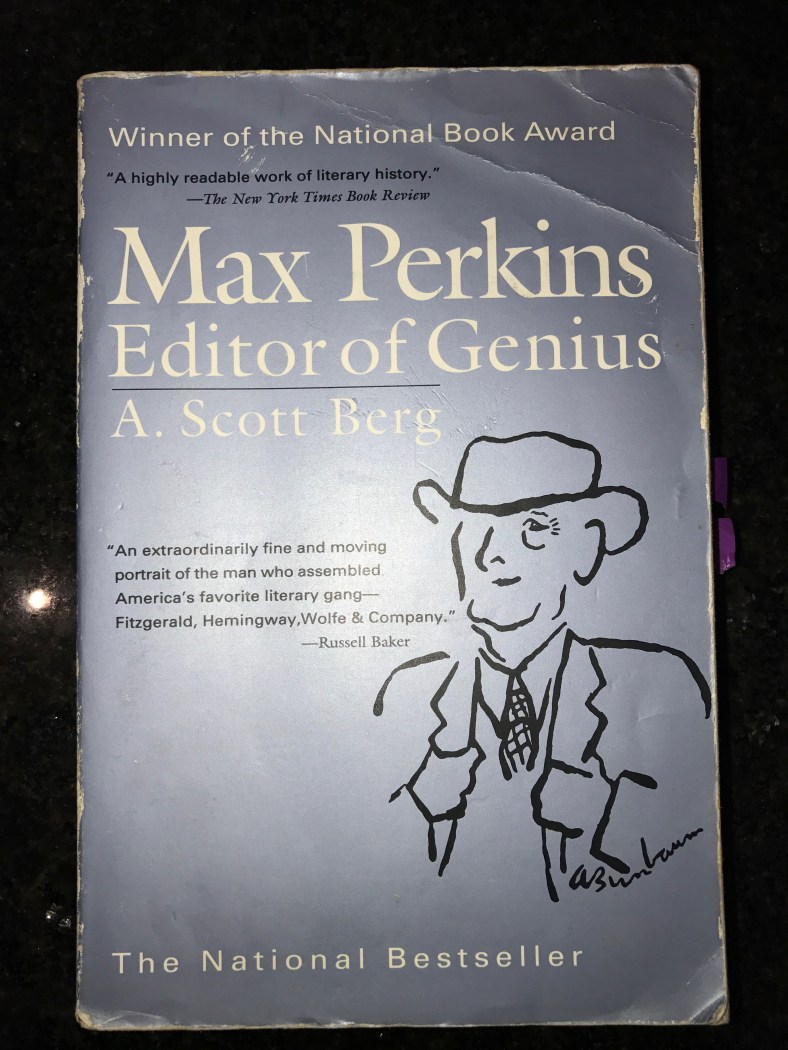 As you can see by the well-worn cover, I love this beautifully written 1978 biography of the editor, Max Perkins. It’s not so much a how-to book on writing but a story of how a humble though intellectual man discovered, fought for and supported his list of writers, many of whom became famous.
It’s an inspirational book about the process of writing and how it renders even well-established authors terminally insecure. I also loved the deep discourse between his stable of writers on writing. If you’re looking for inside stories about authors such as Hemingway, Fitzgerald, Wolfe, Rawlings etc. (not many women, sigh) then this is a good book to dip into when you’re in the mood.
Key take outs:
Score: 10/10
 The creative, writing life can be isolating. Remember this when you’re feeling like that.
Writing routines are great (see this post about how to create one), but what about those times when you’ve done everything right (have you, really?) and you still don’t feel like writing? Perhaps you get annoyed at yourself for not using your time optimally, which makes you feel worse and even less like writing. So you decide not to write today but rather to wait for inspiration.
Only it doesn’t come next time you sit down to write, nor does it come the next time or the time after that. At this rate it’ll be years before you’ve completed your first draft. Surely there’s a better way.
I recently attended a great workshop on remembering your creativity with author Sue Woolfe. She’s turned to neuroscience to understand how the creative mind works in order to optimise creativity after being somewhat stuck with her own writing process. Here are some gems I took away with me that have lifted a weight off my shoulders and made writing fun again.
We used to believe that so-called creative people had ideas constantly flowing through their minds. A study done in the mid-seventies discovered that instead such people’s creativity dipped sharply before taking off exponentially. This is known as the lull. By decreasing brain activity or going into stillness, we allow the creative parts of our brains to activate. Begin your creative time by de-focusing and see what happens. Remember, we are all creative beings and problem solvers by necessity.
It’s not possible to write a perfect story in one hit. You need to do the creative—often called the vomit draft, first. Then you begin the editing process, fixing your story by bringing in structure and order to it etc.. As Sue said, you need to make the clay before you begin the sculpture. Here’s why…
This is critical. For so long I would write a section of my story then edit it. Then I would edit the whole chapter and next the chapters before it. I was fearful that if I didn’t, I would end up going down dead-end paths. The problem was I became stuck in an endless editing loop and my stories’ progress was slow and stilted. Most critically, I was no longer having fun writing. Here’s the reason. Apparently when we edit we engage the frontal lobe. It carries out higher mental processes such as thinking, decision making, and planning. The problem is the frontal lobe isn’t connected at all to the creative part of our brains. This means that when we engage our editor we’re switching off our creative thought processes. So turn your editor off, go into the lull, trust yourself, and see what comes out. It may be half rubbish but it also might lead you somewhere exciting and new, adding depth and beauty. You can always go back and fix it later. Better an imperfect something on the page than a perfect nothing.
By observing Sue’s advice I’m enjoying writing again. When I look back over the previous day’s work (briefly and without editing, of course), I sometimes can’t remember what I’ve written and am pleasantly surprised. Characters are taking over, which deepens point of view and adds authenticity.
Give it a go. What have you got to lose?
This is my very first post and I thought I would start with something that’s relevant to just about every writer. How to establish—and stick to—a writing routine.
People can have romantic ideals about writing. While your first draft of your first novel might be inspired and flow from you easily like water in spring down a stream because you haven’t yet let the critical editor in you take over, much of writing comes down to discipline, commitment and hard work. That’s perfectly normal so instead of blaming yourself for not being one of those naturally ‘inspired’ people, build a writing routine and see what happens. What have you got to lose?

