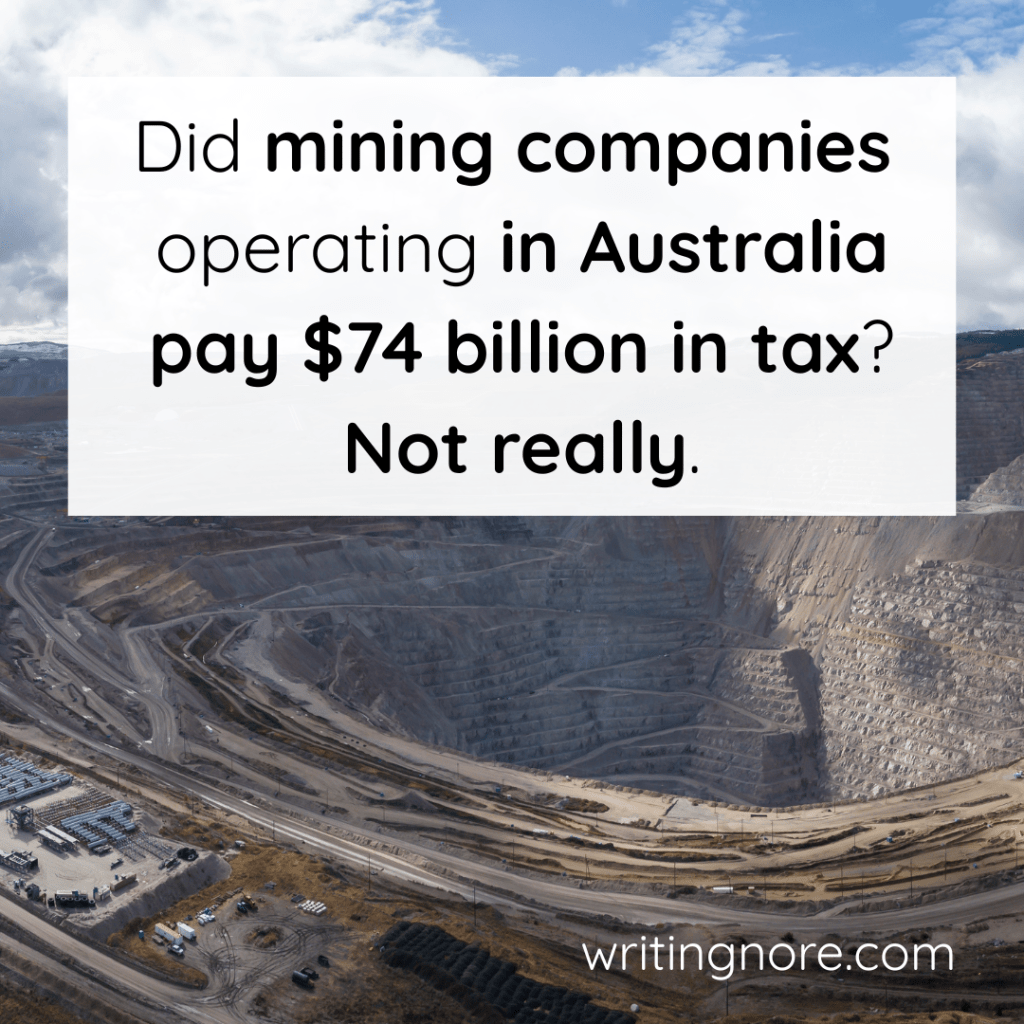
Have you seen the Australian mining lobby’s ad that claims it “pays $74 billion in tax.”
This sounds like a lot. But I knew that number was a manipulation of statistics. So where does that figure come from?
The $74 billion combines federal company income tax + state royalties eg in FY 2023, mining paid $43 billion in company tax and $31.5 billion in royalties, totalling roughly $74 billion.
But royalties aren’t a tax on profit — they’re payments for extracting publicly owned resources. It’s essentially the price of digging up minerals that belong to Australians. And by the way, Australian royalties are relatively low by international standards.
When you look closer at mining in Australia
- Corporate tax is only paid on profits — and many large mining companies legally reduce taxable profit through deductions, depreciation, debt loading and carried-forward losses
- In some years, major resource projects have paid little or no company tax despite significant revenue
- Mining represents only a small share of total government revenue — most funding for hospitals, schools and the NDIS comes from personal income tax, small businesses and broader company taxes
- A substantial portion of mining profits flows offshore to multinational parent companies and foreign shareholders
Environmental rehabilitation and abandoned mine clean-ups can end up costing Australian taxpayers billions
Compare that to 2010 when Prime Minister Kevin Rudd proposed a 40% “super profits” tax on mining windfalls — arguing that when global prices surge, Australians should receive a larger return from their publicly owned resources.
The industry responded with one of the biggest advertising campaigns in Australian political history – largely led by the Murdoch press, destabilising Rudd’s leadership and causing a spill that arguably contributed to a Labor loss int he next election. You may not have voted for Rudd or liked him, but what happened was undemocratic, and should not be allowed to happen to any side of Australia politics.
Rudd’s policy was then watered down, and soon after repealed by the Coalition.
Compare that to Norway that has a similar natural resource base. It taxes petroleum profits, for example, at around 78% and channels surplus revenue into its sovereign wealth fund — now worth over US$1 trillion. That fund invests globally to secure long-term prosperity for future generations.
Just like in Norway, finite Australian-owned public resources should create permanent national wealth.
Australia experienced one of the largest mining booms in modern history and has one of the world’s richest mineral endowments. Instead of building a comparable sovereign wealth buffer, we largely exported finite resources, allowed significant profit repatriation, and captured a relatively modest public return. We effectively exported finite resources while retaining limited structural gain.
The issue isn’t whether mining pays something.
It’s whether Australians are receiving a fair share of the wealth generated from resources that legally belong to them. Individuals pay tax, while offshore multinationals are being allowed to legally steal from the Australian people.
 writing nore