Writing Book Review – The Forest for the Trees by Betsy Lerner

IMG_9872.JPG

Another oldie but goodie is Betsy Lerner’s The Forest for the Trees: An Editor’s Advice to Writers. Its good less so for technical advice but strong on how to deal with the roller coaster ride that is writing from the point of view of an experienced editor.

Lerner helps you sort out what kind of writer you are, and therefore what strategies you might need to invoke to get that manuscript finished, how to deal with rejection and has some practical advice for what editors are looking for and what publishing is like for authors. It’s done with compassion and humour.

Key take outs:

  • Editors see themselves as de facto therapists in that their ‘author presents a set of symptoms as clearly as a patient visiting a doctor…When an editor works with an author they cannot help seeing into the medicine cabinet of their soul.’
  • She has many great quotes, including this one from Don DeLillo: ‘The writer has lost a great deal of influence, and he is situated now, if anywhere, on the margins of culture. But isn’t this where he belongs? How could it be any other way?…This is the perfect place to observe what’s happening at the dead centre of things…The more marginal, perhaps ultimately the more trenchant and observant and finally necessary he’ll become.’
  • I’m not alone, there are other writers out there like me. Writing is hard for many people and that’s normal. Phew!

Score: 8/10 Reassuring

The value of morning pages for writers

IMG_0286

Recently I began doing morning pages again. Morning pages are Julie Cameron’s idea from her book The Artist’s Way on how to improve creativity. They involve doing three longhand pages of stream-of-consciousness writing (or even drawing) about anything top of mind each morning. Usually this takes me 20-30 minutes.

I read Cameron’s book years ago and tried them but didn’t find them particularly useful. Recently I saw her give a lecture and was reminded about them so I thought I’d try them for a few days.

Well, I’m a convert. I do them on most working days now and they’ve been quite remarkable. These are the things I’ve found they help me with:

  • Setting daily priorities.
  • This includes setting writing goals and not letting them disappear amid other life demands.
  • Coming up with ideas on how to overcome writing problems. Later, when I attack them on the page, they don’t seem nearly as daunting.
  • Venting and get things off your mind so you can focus better without such annoying distractions.
  • Other things that have been bothering me suddenly come up on the page, usually with a resolution. Afterwards I feel a sense of clarity and lightness.
  • They just make everything deeper, no matter how irritated I feel about doing them.

I find if I don’t do my morning pages, I’m less focused, my goals are less defined and I achieve less. My time fritters away and I end up feeling a diminished sense of achievement and even frustration compared to when I do them.

Maybe you don’t need them right now, but they’re a good thing to bear in mind should you find writing becomes more challenging. Happy writing.


The First Draft

IMG_0235.PNG

Do you let your first draft rip never looking back, or do you rewrite as you go meaning your first draft is a partial rewrite? Maybe you find it impossible not to constantly go back to earlier writing, interrupting your progress and flow?

Do you wonder how bad your first draft can be? Is it OK if it’s cringeworthy rubbish, or does that mean you’re a talentless writer?

  1. How bad can your first draft be?
    First drafts are often really, really bad. As Ernest Hemingway said, ‘All first drafts of anything are shit‘. I find great comfort and relief in this. When I reread my first draft, it’s little more than a basic plot outline using simple words. I just need to get something down, a structure of events, that I can build on. Often there’s no flourish, sumptuous description, depth or complexity and there’s plenty of cliché, redundancy and repetition etc.. If you’re like me, you’ll be relieved to know this is perfectly normal.
  2. How first draft is a first draft?
    Depending on my writing flow, I sometimes finish a section or chapter, then go back and improve the words before writing the next part of my story. This draft is by no means final. That comes much later after a lot more work when I also look at structural and other matters. But I want my work to have some substance before I move on. Here’s why…
  3. Fixing the words – what am I really trying to say?
    Fixing the words it the best part of writing for me. It’s what makes me want to write, and brings excitement and joy to a challenging process. I also find it — as often happens to be the case in life — the most difficult part of writing. You know, yin and yang, growth comes from challenge etc..

    I’ve long thought that when rewriting or editing the key question to ask yourself is, What am I really trying to say? I watched an interview with author Sophie McManus in which she confirmed this. She went on to say that when a writer redrafts, they’re responding to technical questions about how to improve a sentence. It’s only then that the writer discovers the real meaning of what they’re writing because this is when they’re forced to ask what they really mean to say. In particular, this requires a focus on nouns and verbs, which I’ve posted about before.

  4. Creating versus rewriting and editing
    In this post here I talked about how you can’t create in editor mode because these processes use different parts of the brain that are not connected. But this doesn’t mean you can’t switch from one to the other, if it works for you. Perhaps you’re able to create in the morning or create on one day and rewrite in the afternoon or the next day. It’s OK too to get your first draft done in one hit before even rereading what you’ve written. You’ll know what’s best for you.
  5. Continual redrafting
    It’s critical, however, that you don’t get stuck in continual redraft mode, perfecting your words before you even get to the end.  This is an endless loop that can delay your project significantly.

    Seek perfection later. There’s a reason for this. It’s only when you have a complete plot with an ending that you can fix the sentences so that each one helps build your story in that direction. How will you know what’s missing or redundant, how will you know which words are most apt if you haven’t written the ending yet? Even if you think know your ending, there will be changes along the way that will impact your words. Trust your creative process.

  6. Just write it, confident or not
    You don’t have to feel confident as you write your first draft. Getting something down on the page is a start. Remember, you can’t rewrite or edit a blank page. Don’t let fear of writing poorly or going down a dead-end path hold you back.

    When you’re ready to rewrite, keep working on the language until it gets to the point where you’re saying something in a style or voice that knows its purpose, even if you don’t consciously know at first what your story is truly about. Ironically, through technique, writers create meaning, beauty and art.


Writing Book Review – Writing the Breakout Novel by Donald Maass

IMG_8202.JPG

This writing book aims to help you take your fiction to the next level. If you know the basics of writing, it’s a great guide on how to do this. I found it practical as well as motivating.

Maass talks about the premise, stakes, time and place, character, plotting, POV, endings, and I love that it also discusses theme. In short, it’s pretty thorough.

Key take outs:

  • The great novel should sweep you away with unforgettable characters, and dramatic and meaningful events. The essence of a great story is conflict.
  • High stakes come from your own stakes in writing your story. An author who is fired up, or rather who fires up their characters as their proxies, stands a much better chance of crafting a spellbinding story.
  • Use exposition – interior monologues – in which there is no action to deepen dilemmas and increase tension e.g. irresolution and mixed feelings.
  • To set your voice free, set your words, characters and heart free.
  • Novels are moral. Say something passionately that must be said.

Score: 9/10 It works

Waiting to be published

IMG_0117.PNG

So you’ve completed your manuscript. Before you send it off to publishers, make sure it’s the best it can be. Not just the best it can be right now, but best FULL STOP. Often we get impatient and send our manuscripts out into the world too early when we should put them away for a couple of months before reviewing them again, send them off to a professional for an assessment or do yet another draft. But let’s say you’ve done all that and your book is the best it can be. You truly believe in it.

You compile a list of publishers and you send it to them. You’ve spent the time you need to write each personalised letter, hone your pitch, nail your marketing strategy, write gripping synopses of varying lengths and a fascinating author bio. Off your MS goes into the wilderness (with a touch of that true belief).

Now you wait. Perhaps you get bites for more of your MS. Perhaps you succeed quickly – someone wants to publish your book. Yay you. Congratulations! But if you’re one of the majority who either hear nothing back (“assume if you haven’t heard from us within three months that we’re not interested”) or get outright rejections, then what?

  1. Sulk
    This is a normal human reaction. Allow yourself a set time, say one day, to sulk during which time you’re allowed to indulge in all your self-doubting thoughts such as what a crap writer you are, you’re never going to get published, you’ve wasted your time and you’re definitely going to give up.But once your twenty-four hours are up, it’s time to stop the tantrums and get on with it. You have a choice to make. Do you want to write or not? Ask yourself why you’re writing and who you’re writing for? If the answer is anything other than you’re writing because you need to and that you’re doing it for yourself, then you might need to have a good hard think about your motives. Good writing comes from truth and honesty, from baring your soul, not from dreams of fame and certainty. This is not that kind of career. Writing demands vulnerability because that’s the creative process.
  2. Get detailed feedback
    If you don’t want to give up on your story yet, you could take on board the feedback you’ve received from editors and begin a re-draft. For deeper feedback before you begin re-drafting, get a manuscript assessment done. You should end up with a thorough twelve-page report that assesses everything about your novel from structural issues, voice, character, style and so on. These can be very helpful. This is a lot cheaper than hiring an editor, which is another option. If you can afford an editor, they will take you through your MS line by line as well as giving you a detailed report. Just make sure they believe sufficiently in your writing and your story before, and that your MS is ready. Going down the editor path costs thousands of dollars so getting the right person at the right time is critical.
  3. Retire your story
    No one else can tell you if your story is worth persisting with or not. But perhaps, after much thought, you’ve realised this was your learner book and that you don’t want to salvage it. Perhaps you know in your gut it’s time to let it go. For many published authors their third book is the one that gets published. Say thank you to your story before putting it away for good. Also, pat yourself on the back for having finished a novel. That’s not something that a lot of people do, even though many try. Now you’re free to start the next story bringing along everything you learnt from your first. This might be a good time to do a course or read a new book on writing, something that inspires and strengthens you.
  4. Self publish
    If you’re satisfied your story is the best it can be and really do believe in it, perhaps self-publishing is the right option for you. It’s a bit of a learning curve, but there are many free and paid websites, eBooks and courses full of step-by-step how-to advice, including on how to market your book. Marketing is a skill you’ll need no matter which way you publish as most publishers don’t have large marketing budgets these days. You can publish an eBook only or give people the option of buying a print-to-order hard copy. If you decide to hire someone to do the work for you, be very cautious. Most such companies, including some owned by the big publishing companies, do very little for thousands of dollars. They’re in that side of the business to make money, and by all reports they’re raking it in. Do your research first.

The important thing is not to be beaten in the process of getting published. You may view not finding a traditional publisher as failure, but failure is simply another form of feedback. Use it wisely and keep moving ahead.

Writing Book Review – Max Perkins: Editor of Genius by A Scott Berg

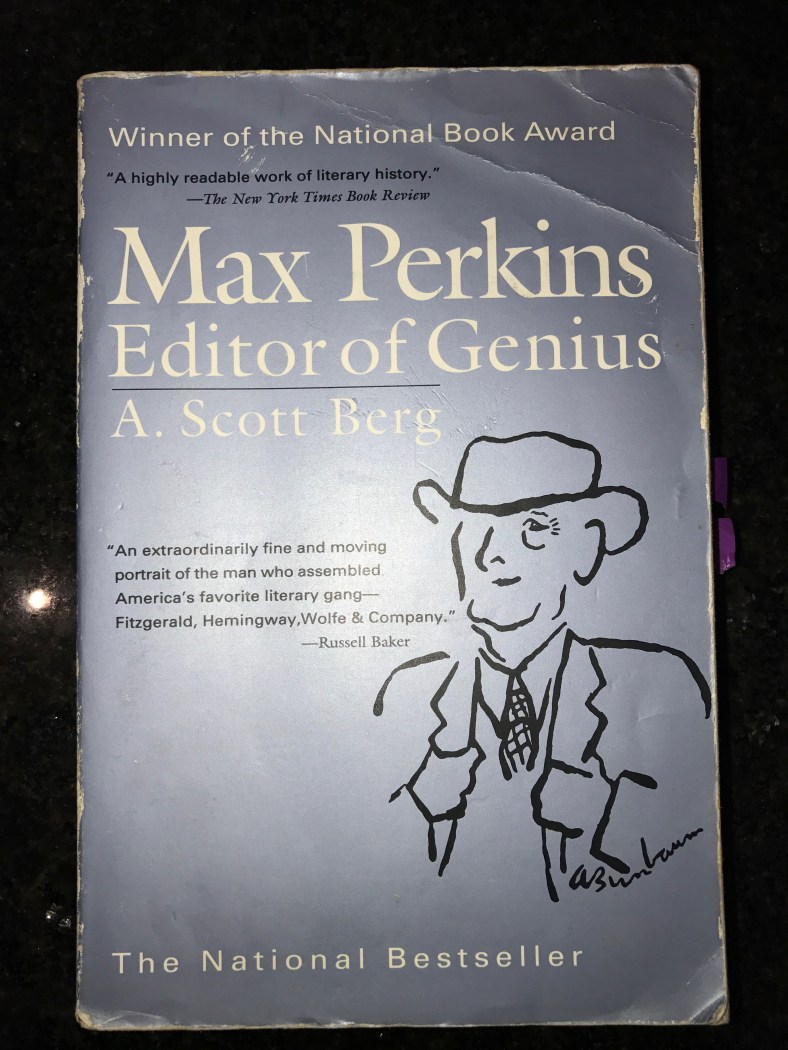
IMG_3732As you can see by the well-worn cover, I love this beautifully written 1978 biography of the editor, Max Perkins. It’s not so much a how-to book on writing but a story of how a humble though intellectual man discovered, fought for and supported his list of writers, many of whom became famous.
It’s an inspirational  book about the process of writing and how it renders even well-established authors terminally insecure. I also loved the deep discourse between his stable of writers on writing. If you’re looking for inside stories about authors such as Hemingway, Fitzgerald, Wolfe, Rawlings etc. (not many women, sigh) then this is a good book to dip into when you’re in the mood.

Key take outs:

  • It gives inspiration and comfort about how fickle the writing process can be
  • Cut out every word that is not essential to the meaning of the writing
  • Great writers take great risks e.g. Tom Wolfe saying he’s “going into the woods for two or three years” to “try to do the best, the most important piece of work I have ever done.”

Score: 10/10

When you don’t feel like writing

IMG_0076.PNG

Writing routines are great (see this post about how to create one), but what about those times when you’ve done everything right (have you, really?) and you still don’t feel like writing? Perhaps you get annoyed at yourself for not using your time optimally, which makes you feel worse and even less like writing. So you decide not to write today but rather to wait for inspiration.

Only it doesn’t come next time you sit down to write, nor does it come the next time or the time after that. At this rate it’ll be years before you’ve completed your first draft. Surely there’s a better way.

  1. Know that it’s normal
    Not feeling like writing is normal. Feelings are indicators. Acknowledge them, which is all they want, and write anyway. Writing is an action and requires doing. Sometimes by starting your brain complies.
  2. Ask yourself: What is it I’m resisting?
    Writing is a relationship you’re having with deep bits of your mind. Not feeling like writing might mean you’re resisting. Perhaps you’re trying to avoid the pain of writing because it leaves you feeling vulnerable and exposed? Perhaps you’re scared of that pain?Yet, the days when you don’t feel like writing are the days when you must break through this resistance because these are the days when a breakthrough is most possible. If you’re a true writer—if you must write—such days that will define you. Do some deep breathing (in 4, hold 4, out 8, hold 2), cast your feelings aside and write.
  3. De-romanticise the process
    Know that the professionals—those who make a living from writing—sit down and write whether they feel like it or not. Exorcise all romantic ideals from your head about the inspired artist, the elusive muse or whatever, and move ahead despite your mood or the circumstances of your life. As one writer said, the writing life may be colourful but the writing career is not a romantic one as the work itself is rather drab. Remember, this is something you have chosen to do.
  4. Write badly
    Fake it till you make it. Writing something is better than nothing and it might lead you to a breakthrough or some inspired writing or even just bad writing. But at least you’ll have the self-respect that comes from trying your best.
  5. Read something inspiring, then write
    We all know that we learn from reading, often subconsciously, so read work that’s going to life and inspire you. Then wait for words to flow out of you. As writers we all need to read regularly. It’s part of the job.
  6. Copy out a couple of pages of inspiring writing
    Copy out a few pages from one of favourite books or pieces and then write. Perhaps you’ll produce the best two paragraphs ever, or two pages of dribble. Do it anyway.
  7. Free write
    Write for ten minutes or two pages letting whatever comes out fall onto your page. Again, anything to get your juices flowing.
  8. Outline rather than write
    Perhaps you’re daunted by the blank page. Consider where you’ve been in your story and where you need to go next (just not too far ahead). I have a kind of knowing in my gut about this; when it’s time for a character to come back or for some serious action etc.. Go with that and begin. The next day won’t be nearly as daunting.
  9. If you’re enjoying your story, but not the words
    Write the story and don’t worry about the words. Who said everything had to be perfect first time around? You can go back and fill in the words later. This is the vomit draft, also known as the creative fun part of the process before the editor in you steps in.
  10. If you’re enjoying the words, but not the story
    The story is annoying you perhaps but you’re loving a character or what they have to say. Indulge in those words and let the story fall out.Alternatively, there could be something wrong with the story, which means you need to fix it before you can write again.
  11. Reward yourself
    Now that you’ve resisted the temptation to give in to your mood, reward yourself. Best not with food, I think, as it has too many connotations. Have a bath, take a walk, sit in the sun, watch your favourite TV show, do some yoga, meet a friend for coffee. Just make it something that’s positive for you.


Optimising Your Creativity

IMG_0055.PNG

I recently attended a great workshop on remembering your creativity with author Sue Woolfe. She’s turned to neuroscience to understand how the creative mind works in order to optimise creativity after being somewhat stuck with her own writing process. Here are some gems I took away with me that have lifted a weight off my shoulders and made writing fun again.

  1. Stillness

We used to believe that so-called creative people had ideas constantly flowing through their minds. A study done in the mid-seventies discovered that instead such people’s creativity dipped sharply before taking off exponentially. This is known as the lull. By decreasing brain activity or going into stillness, we allow the creative parts of our brains to activate. Begin your creative time by de-focusing and see what happens. Remember, we are all creative beings and problem solvers by necessity.

  1. Writing is a two-part process

It’s not possible to write a perfect story in one hit. You need to do the creative—often called the vomit draft, first. Then you begin the editing process, fixing your story by bringing in structure and order to it etc.. As Sue said, you need to make the clay before you begin the sculpture. Here’s why…

  1. You must turn your editor off

This is critical. For so long I would write a section of my story then edit it. Then I would edit the whole chapter and next the chapters before it. I was fearful that if I didn’t, I would end up going down dead-end paths. The problem was I became stuck in an endless editing loop and my stories’ progress was slow and stilted. Most critically, I was no longer having fun writing. Here’s the reason. Apparently when we edit we engage the frontal lobe. It carries out higher mental processes such as thinking, decision making, and planning. The problem is the frontal lobe isn’t connected at all to the creative part of our brains. This means that when we engage our editor we’re switching off our creative thought processes. So turn your editor off, go into the lull, trust yourself, and see what comes out. It may be half rubbish but it also might lead you somewhere exciting and new, adding depth and beauty. You can always go back and fix it later. Better an imperfect something on the page than a perfect nothing.

  1. Conclusion

By observing Sue’s advice I’m enjoying writing again. When I look back over the previous day’s work (briefly and without editing, of course), I sometimes can’t remember what I’ve written and am pleasantly surprised. Characters are taking over, which deepens point of view and adds authenticity.

Give it a go. What have you got to lose?