Make your text come alive with verbs & nouns

Verbs and nouns are the cornerstones of vivid, impactful writing. When chosen deliberately, they provide a direct, tangible connection between the writer’s imagination and the reader’s experience.

I learned this after doing a short course, and it’s probably the most valuable writing lesson I learned. At the time, I was struggling to make my text more impactful in line with my dramatic storyline.

Part of the reason verbs and nouns work so well is that they avoid the need for wordy and repetitive adverbs and adjectives. Then, when you do decide to use them, they have a greater impact.

Why verbs & nouns are vital

  1. Verbs drive action
    • Verbs create movement and momentum in the narrative. They signal what’s happening, transforming static description into dynamic scenes, drawing the reader in and holding their attention
    • For example, compare “The dog was in the yard” (static) with “The dog launched itself across the yard” (dynamic)
    • Strong, precise verbs eliminate the need for excessive modifiers like adverbs, and they streamline prose, maintaining energy
  2. Nouns anchor reality
    • Nouns on the other hand, ground the reader in the sensory world, offering specificity and detail
    • For example, “Tree” is a generic noun, but “oak” or “willow” conjures a precise image, enhancing the reader’s experience
    • Specific nouns evoke emotions and associations. Consider the difference between “a chair”and “an antique rocking chair”
  3. Engage the reader’s imagination
    • Vibrant verbs and specific nouns invite readers to visualise, hear and feel the scene
    • For example, “The waves crashed against jagged rocks” engages sight, sound and motion, while “The waves were loud” falls flat

How to use verbs & nouns effectively

  1. Choose precise verbs
    • Avoid generic verbs like “is,” “have,” and “go.” Replace them with more vivid alternatives
    • For example, replace “The car went down the road” with “The car zoomed down the road”
  2. Opt for concrete nouns
    • Use nouns that evoke clear, tangible imagery
    • For example, instead of “fruit,” say “juicy pomegranate” or “ripe mango”
  3. Balance action with description
    • Verbs and nouns should complement each other. A powerful verb paired with a weak noun loses impact, and vice versa
    • For example, “The child stumbled on the cobblestones” is stronger than “The person walked on the path”
  4. Avoid overloading with adjectives and adverbs
    • Strong verbs and nouns often eliminate the need for extra description
    • For example, “He sprinted” is more effective than “He ran quickly”

What this achieves

  1. Immersive experiences
    • Readers can see and feel the action, making the text resonate emotionally
  2. Rhythmic flow
    • Strong verbs and nouns create a cadence in the prose, drawing readers forward effortlessly.
  3. Memorable imagery
    • Specific nouns and verbs linger in the reader’s mind, making the text unforgettable
  4. Reader engagement
    • Action-packed, sensory-rich sentences hold attention and invite deeper connection

Examples

Weak The man was in a hurry as he went through the forest, looking at the trees.
Stronger The man dashed through the forest, scanning the towering pines.

Weak The cat was on the roof, making noise.
Stronger The cat yowled atop the tin roof.

By deliberately crafting sentences with vibrant verbs and evocative nouns, your writing can leap off the page and pull readers into a living, breathing world.

Find out more about Gunfire Lullabies, writing and me in these podcasts, interviews and features!

The Empty Page podcast

Find out about my writing and publishing process for Gunfire Lullabies? Click here to hear my interview with Gavin Miller and The Empty Page podcast. Lots of fun.

Talking Aussie Book podcast

Learn more about the origin of Gunfire Lullabies on this podcast interview I did with Claudine Tinellis on Taking Aussie Books. Great in depth questions.

Ten Terrifying Questions with Booktopia

Booktopia asked me Ten Terrifying Questions revealing more about the person behind the novel. Check it out here.

AJC Publishing Author Interview

Read a different angle on Gunfire Lullabies and my writing process here.

The Australian Financial Review Weekend story

I wrote a piece for the Fin Review charting my journey from diplomat to novelist. Read it here.

For more interviews, check out my media page!

Just click here 🙂

Writing – Should you pick up where you left off or start over?

My second novel is 40,000 words in. I began writing it in 2010, and since then have added sections in spurts, mainly in 2017.

In 2022, 11 years on and 5 years since I last added anything significant, I’m determined to finish a solid first draft.

But should I start again?

An old friend of mine wrote an award-winning novel in two parts, and they read very differently. I liked the second half much more than the first, and didn’t feel it worked to have two markedly varied styles in the same book (yet clearly others didn’t mind).

Some things I’m considering:

  • My writing has evolved, significantly improving since 2010 and 2017 (you’d hope so!)
  • While the story line is the same, the theme has deepened to consider current events
  • I was never happy with the voice of the main child character. For me, voice takes several drafts to get right, so this may not require me to start over. Hmm…
  • Yet I also feel I know the main character better, who is inspired by my parents and some of their experiences during WW2
  • I’m wondering if I should change the point of view to more authorial, from one person to two or more. But this has always been a dilemma I’ve needed to act on
  • It’s a bit of a mess because I’ve written it in fits and starts

I think the answer is clear for me. I need to ditch the other work out and begin again. I also did this with my published novel, Gunfire Lullabies, which I wrote in three very different drafts. This came to me after having heard about process writing The Narrow Road to the Deep North, which I still thought was quite fractured.

My main reason?

  • The theme – The other aspects I can correct with some rewriting / editing, but having an altered theme changes everything – syntax, style, plot, point of view and character even, as I now want them to represent something additional

What’s your experience of picking up a story you’ve partly finished?

The courage to write opinions

'Courage is not the absence of fear, but rather the judgement that something else is more important than fear.' Ambrose Redmoon.png

Hi everyone

My blogs have, until recently, been all about writing.

With the publication of my debut novel in August, I’ve decided to change tack and write some opinion pieces.

You may have seen my piece about Anzac Day, which stirred up strong feelings as many of us have relatives who are or have been involved in wars, or indeed may have experienced them ourselves.

Some of my new blogs will be opinion pieces on topics I feel strongly about. Hence the quote about courage, because some of it will be close to the bone. Gulp. I don’t know if anyone will be interested in reading them, but it’s important for me to write them.

Others will continue to be about writing. For example, I plan to write about the what the editing process is like from the inside.

Keep on writing. Keep on reading. Keep on thinking you creatives and thinkers. Never, ever give up. 

Nore xo

Do your words convey your intent?

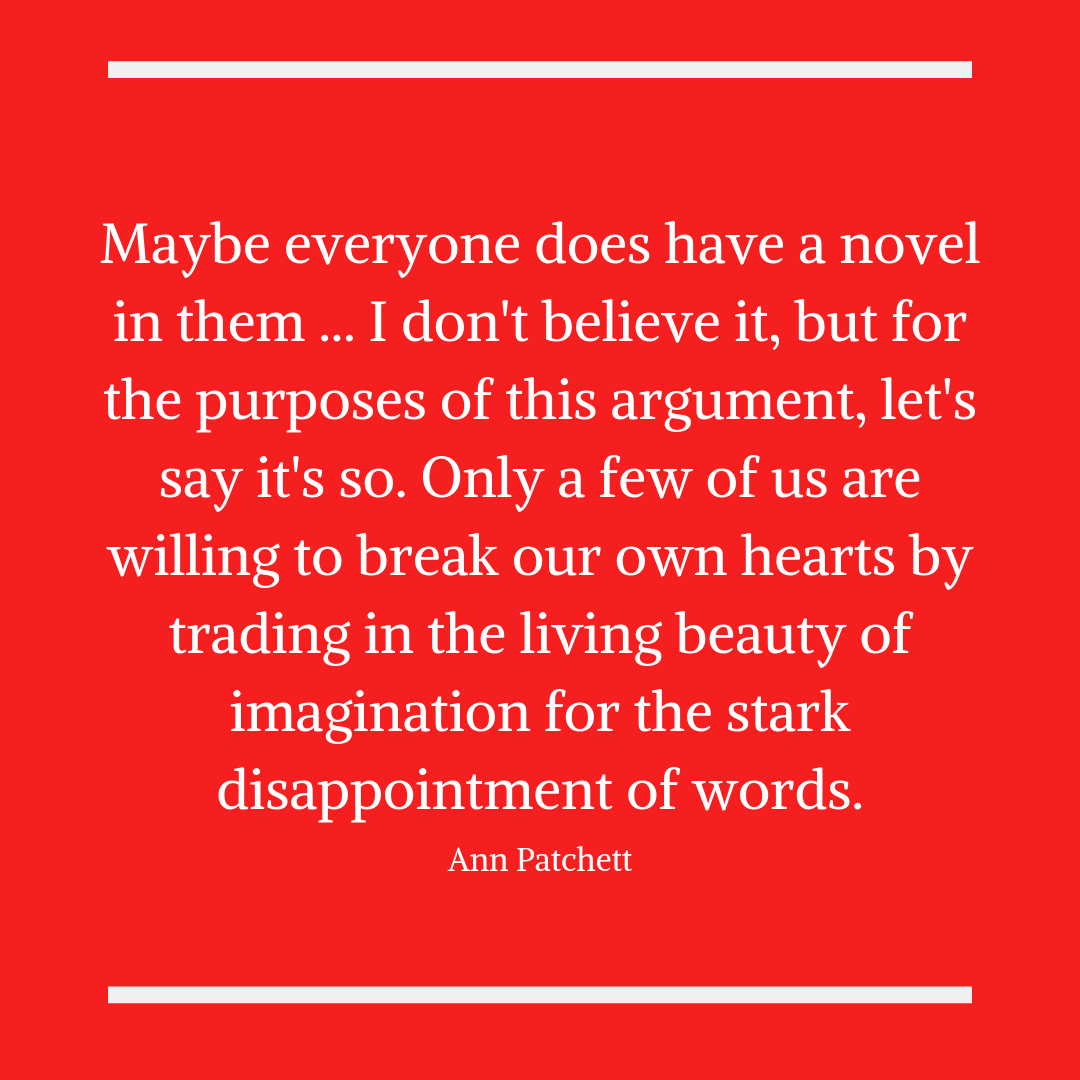
Ann Patchett’s quote is only too true. That said, it’s during my many (and I mean many) edits that I attempt to unearth the words I hope will go some way towards evoking the feeling I want to convey. Sometimes I can spend two hours on a key paragraph. I personally love writing where my emotion and understanding are greater than the sum of the words. This is true art.

Maybe everyone does have a novel in them ... I don't believe it, but for the purposes of this argument, let's say it's so. Only a few of us are willing to break our own hearts by trading in the living beauty of imagi.png

Creating is messy

No extraordinary journey is linear.png

The full quote from Scott Belsky goes like this:

‘No extraordinary journey is linear. The notion of having established ideas and making consistent incremental progress is impossible. Those seeking a linear journey can still be successful, but often they struggle to create anything new.’

Something to remember when your work in progress isn’t doing what you want it do to. Now, get on with your creating 🙂

Baring my writing soul

IMG_5026.PNG

I started writing a novel in 1993 after finally getting my Arts degree (and having two kids). I didn’t believe in it or myself enough and gave up.

I went and lived: Got a job, worked overseas, witnessed revolution and war, got divorced and had a relationship with an abusive guy.

I wrote another book inspired by some of these events, this time fully supported by my new partner. I received publisher interest, but was rejected many times.

Each time I picked myself up off the floor and went back to the drawing board. I wrote three different versions of my story over 13 years. That’s around 4 years per book! (It doesn’t feel that long.)

Late last year a publisher finally said, ‘I love it. Let’s do it!’

My debut novel, Gunfire Lullabies, will be published in August 2019.

My message to my fellow writers and anyone doing something challenging is:

NEVER give up
BELIEVE in yourself
BE OPEN to constant improvement

And just KEEP ON WRITING!

Now for the next novel…(eek!)